

Power Electronics - November 2024
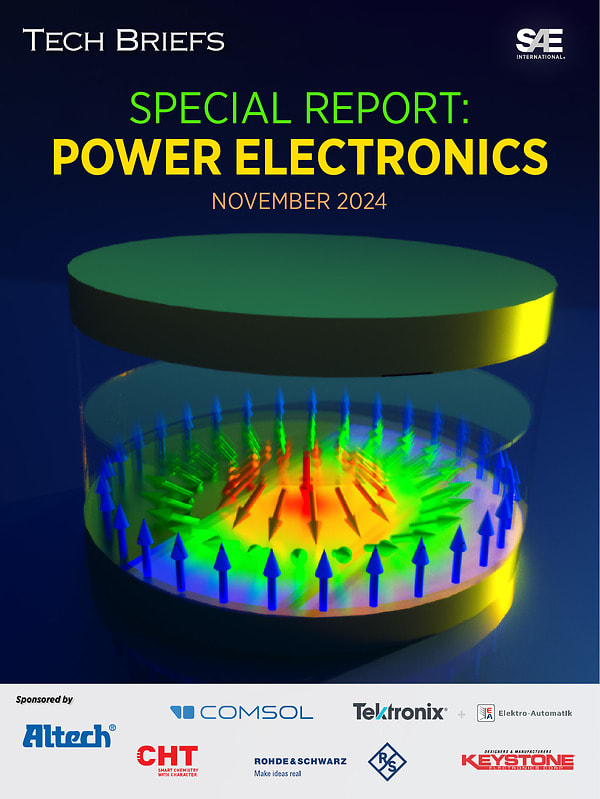
This compendium of articles from the editors of Tech Briefs and Aerospace & Defense Technology magazines looks at the latest advances in power electronics and energy storage for applications ranging from electric vehicles to battlefield systems to high‐performance computing in manufacturing and healthcare.
Don't have an account?
Overview
The November 2024 Special Report on Power Electronics presents a comprehensive overview of recent advancements and innovations in the field, focusing on the critical role of power electronics in various applications, including electric vehicles (EVs) and military vehicles.
One of the key highlights of the report is the development of algorithms and multilayered communication systems aimed at enhancing the reliability of electric vehicle chargers. Researchers at Oak Ridge National Laboratory (ORNL) have created algorithms that allow EV chargers to maintain functionality even during voltage drops or disturbances in the electric grid. This innovation not only protects the chargers but also contributes to the stability of the broader electric grid. The system can detect internal failures within the charger and redistribute the load among remaining power modules, ensuring continued operation at reduced power levels until repairs can be made. Additionally, a system-wide controller can manage multiple chargers, optimizing the charging experience for users while balancing energy costs and operational priorities.
The report also discusses the integration of battery storage and solar power to further improve EV charging performance. This approach aims to enhance the sustainability and efficiency of charging stations, making them more resilient to fluctuations in energy supply.
Another significant development featured in the report is the creation of a new microelectronic device by a research team led by the Agency for Science, Technology and Research (A*STAR) in collaboration with the National University of Singapore (NUS). This innovative device functions as a sustainable, high-performance "bit-switch," utilizing magnetic whirls known as skyrmions to operate with 1,000 times less power than conventional memory technologies. This breakthrough is particularly relevant in the context of emerging AI technologies, which require substantial computing power and energy. The report emphasizes the importance of edge computing as a solution to the growing energy demands of data processing, allowing for more efficient operation within individual devices rather than relying on large-scale data centers.
The report also touches on the challenges facing the mass-market adoption of solid-state batteries, highlighting the need for advancements in battery chemistry and the establishment of production capacity to meet market demand. The ongoing research in this area is crucial for the future of energy storage and electric mobility.
In summary, the November 2024 Special Report on Power Electronics showcases significant advancements in the field, particularly in enhancing the reliability and efficiency of electric vehicle charging systems and the development of innovative microelectronic devices. These innovations are paving the way for a more sustainable and efficient future in power electronics, addressing the growing energy demands of modern technologies while ensuring the stability and resilience of energy systems. The report serves as a valuable resource for industry professionals, researchers, and stakeholders interested in the latest trends and developments in power electronics.











