

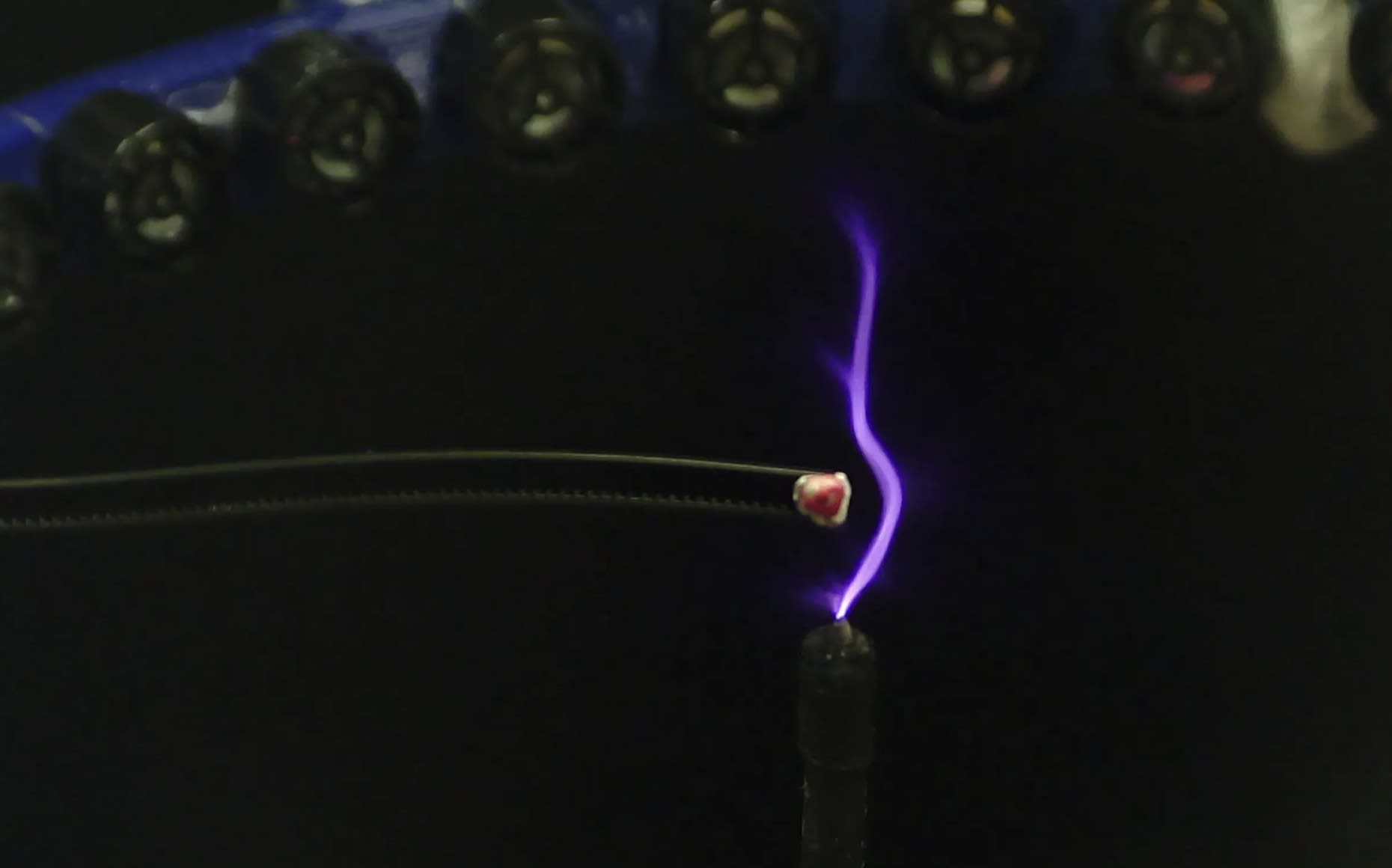
Electric sparks are used for welding, powering electronics, killing germs or for igniting the fuel in some car engines. Despite their usefulness, they are hard to control in open space, they split into chaotic branches that tend to go towards the closest metallic objects.
A recent study uncovers a way of transporting electricity through air by ultrasonic waves. The level of control of the electric sparks allows to guide the spark around obstacles, or to make it hit specific spots, even into non-conductive materials.
"We observed this phenomenon more than one year ago, then it took us months to control it, and even longer to find an explanation," said Lead Researcher Asier Marzo, Ph.D., from the Public University of Navarre.
This guidance occurs because the sparks heat up the air, which expands and lowers its density. The hot air is then guided by ultrasonic waves into regions where the sound intensity is higher and the next sparks then follow these regions of lighter air because of its lower breakdown voltage.
"Precise control of sparks allows their utilization in a wide variety of applications, such as atmospheric sciences, biological procedures and selective powering of circuits," said Professor Ari Salmi, University of Helsinki.
Previously, sparks could only be guided with laser induced discharges colloquially called electrolasers which required the use of dangerous lasers, as well as precise timing between the laser and the electric discharge. The developed method uses ultrasound rather than lasers, and it is safe to the eyes and skin. The equipment is compact, affordable and can be operated continuously.
"I am excited about the possibility of using very faint sparks for creating controlled tactile stimuli in the hand, perhaps creating the first contactless Braille system," said First Author Josu Irisarri, Public University of Navarre.
The study was carried out in collaboration between researchers from the Public University of Navarre, the University of Helsinki, and the University of Waterloo. It has been published in Science Advances.
Here is an exclusive Tech Briefs interview, edited for length and clarity, with Marzo and Salmi.
Tech Briefs: What was the biggest technical challenge you faced while developing this method of guiding electric sparks using ultrasonic waves?
Marzo: From my point of view, we found it by chance. We do a lot of ultrasound and were having some high voltage, so we just tried to combine them. We saw the effect two years ago. Then, one next step was controlling it, but it was easy because we are quite good at controlling ultrasound. We saw that the spark follows the ultrasound very well. What was really challenging was to understand why, and that's when we needed the help from Ari.
Salmi: So, what actually caused the electricity to follow the ultrasonic field — that was not the easiest thing to understand.
Tech Briefs: What was the catalyst for this project?
Marzo: We thought that the electricity followed the ultrasound because of a phenomenon called streaming. Here in Spain at my laboratory, we don't know much about it, but I knew that Ari knew a lot about the streaming. It ended up that it was not streaming as the main cause, but that was the contact.
Salmi: I visited, and Asier showed me the phenomenon that they had discovered. I just found it immediately interesting. So, we decided to work on it together, and the result turned out quite nicely. One of my students visited the lab for a couple of months in Spain and did some experiments there. Then, we did some math simulations back home.
Tech Briefs: Can you explain in simple terms how it works?
Marzo: Basically, the electric spark, heats up the air, and when the air heats up, it also expands. That lowers its density. And this region of lower density gets pushed by the ultrasound. And not only that, but it also conducts because in the low-density region, the electricity has a lower breakdown voltage. It's a cycle; it happens all the time.
Tech Briefs: Do you have plans for further research, work, etc.? What are your next steps?
Marzo: Regarding using this guidance for haptics, for tactile sensations, yes. Josu, the lead author of the paper, is going to continue working on that. We did previous research on using the electric spark to create tactile sensations on the hand. But it was hard because the spark was chaotic. It was hitting the hand at different positions. And not only that, we had to move the spark mechanically. So, this research, if we combine both, will be great because now the spark gets guided exactly where we want and we don't need to mechanically move it; we can guide it with ultrasound.
One thing that we wanted was to make it on a larger scale. All our sparks were like four centimeters, five centimeters, and there is nothing that says that it should not be possible to do one meter or half a meter.
Transcript
No transcript is available for this video.











