

The applications are too numerous to list in their entirety. Coffee grounds. Eggshell waste. Pomegranates and pineapples. Manure and paper mill sludge. Tobacco. These are just a few of the materials that require dewatering, a process that — as its name suggests — separates fluids from solids, often converting what would otherwise go down the drain or end up in a landfill into saleable products.
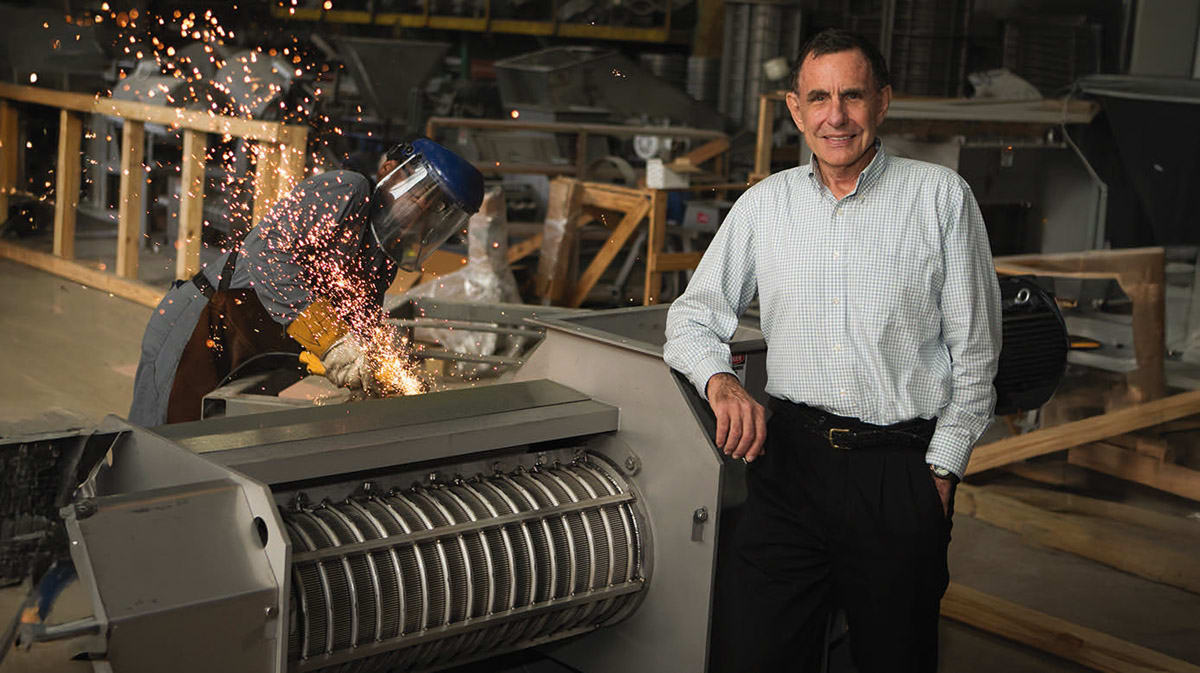
Bob Johnston, Engineering Manager for Vincent Corporation, will tell you dewatering is nothing new, even though he is quick to add that new requests come along every day. “I just returned from a business trip where I took fourteen airplane flights in two weeks. This year I have visited a company in Malaysia that’s begun dewatering waste fiberglass, another in the Caribbean pulling the liquids out of sargassum seaweed, seven factories in Vietnam processing coffee grounds, one in India making pharmaceuticals… it’s a long list,” he said.
This last application required upward of two hundred dewatering units, Johnston added, each equipped with a gearbox from Waunakee, Wisconsinbased NORD DRIVESYSTEMS, whose team he has worked with quite closely over the past 17 years.
His efforts in this area began three decades before that, however, when Vincent began making an entirely different product. He was going around to the juice canneries in those days, collecting the piles of orange peel, putting them in a dryer, and using the dried peel to make cattle feed, said Johnston.
Vincent had a problem, though: before drying the peel, it began to attract flies. That’s when he noticed the canneries were sprinkling hydrated lime (calcium hydroxide) on the piles of orange peels and that water would soon begin running from the bottom as a result. He quickly moved to patent the chemical reaction, then took his idea one step further by squeezing the peels in what would soon be known throughout the industry as a dewatering screw press.
“The reaction breaks down the cell walls, allowing the press to squeeze out a lot more liquid. Since then, we have developed numerous improvements, including using steam or enzymes to enhance the dewatering process even further, but they all center around the screw press,” he said.
Today, Vincent Corp. employs 60 people at its 30,000-square-foot facility, where it manufactures four standard product lines — the original VP Series screw press first introduced in 1952, as well as the newer CP Series, KP Series, and the twin-screw TSP Series. There are also shredding units available that sit over the press inlet and help to break up materials, together with various types of screens and filters, lime dosers, and a host of other accessories.
The company will also design special units to meet unique customer requirements and rent dewatering systems to those with temporary needs. “We have a fleet of over 200 rental machines that come and go,” said Johnston. “Eventually someone will buy one of them at a discount and we will build another to replace it. We also offer free testing so that people can ensure a dewatering system will deliver the desired results before purchasing one of our units.”
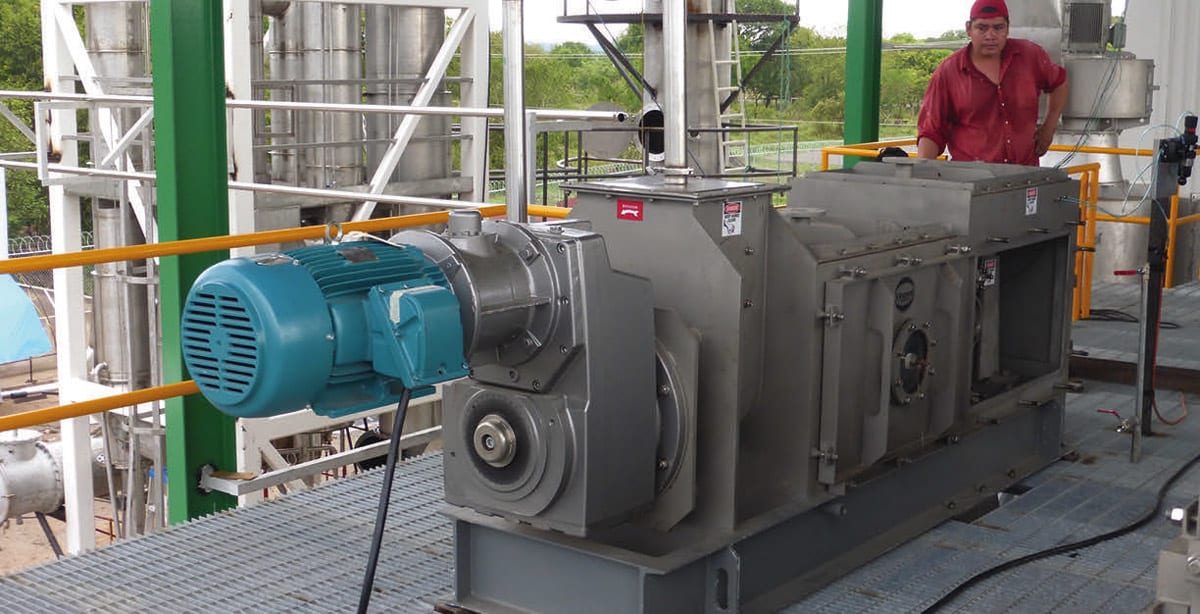
Whether purchased or rented, each dewatering press contains a graduated pitch screw ranging from 4” to 30” in diameter. This is driven by an electric gear motor (supplied by NORD) that turns the screw inside a cylinder with a perforated screen on the inside. Raw material enters one end of the device and is gradually compressed as it travels down the screw, expelling “press liquor” while it goes. An adjustable discharge cone assembly determines how much resistance is applied. At the far end, a now dry “press cake” is discharged, completing the process.
Though the materials can be soft and squishy, significant forces are involved. Johnston said that he and his design group went through numerous gear drive suppliers before finding NORD. “Some of our early units used a shrink disc to attach the screw. Those didn’t work. We actually had to saw the screws in half to get the press apart. Then we switched to a taper grip design and had the same darn problem, not to mention huge warranty expense later on. Since we switched to NORD MAXXDRIVE parallel shaft gearboxes and UNICASE parallel shaft gear units, all that has gone away.”
Johnston pointed out that not everything is as simple to dewater as orange peels and celery stalks. Consider the marijuana mentioned earlier. Here, the “weed” must be soaked in alcohol for an hour or so (to extract the CBD oil) and then fed into the press. The manufacturer then evaporates the alcohol for reuse, turns the remaining crude oil into cannabis products, and sells the pressed cake to pig farms.
A similar story revolves around blueberries, where the liquor is “really valuable,” and the waste skins become cattle feed. “We always split the flow to deliver both pressed liquor and pressed cake,” said Johnston. “Sometimes only one of these is valuable, other times it’s the other, but sometimes it’s both. Either way, we need flexibility in our drive units,”
Johnston recalls a visit from sales representative Ricky Negrón shortly after he had started with NORD years before. When asked about a photo in the catalog showing a heavy-duty bearing option, Negrón had to admit he didn’t know. Yet the still-green salesman came back with an explanation quickly, and Vincent Corp. has been specifying the option ever since.
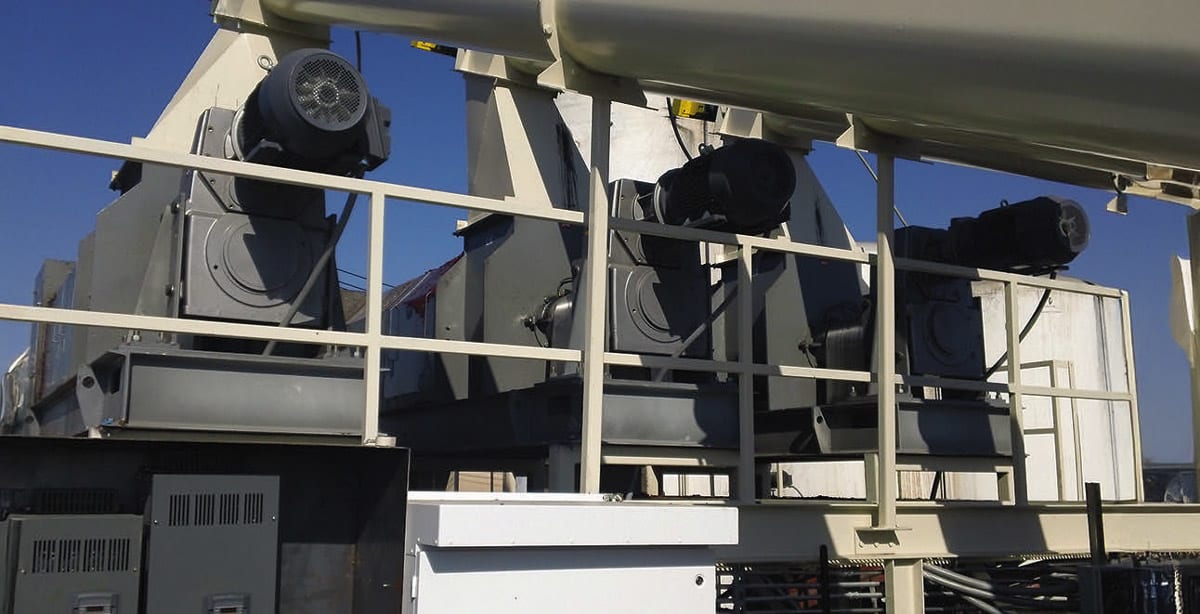
“That gear drive unit not only supports the high axial thrust loads we encounter in dewatering applications, it also lets us crank up the motor speeds much higher than any other unit we’ve tried. This lets us increase capacity without the hassle of spec’ing out a different drive, or try different settings to optimize the unit’s output, or adjust it to solve a specific problem. I have also found that the NORD units are quite compact, which helps in not-uncommon situations where there are space constraints. Lastly, there’s durability. As I stated earlier, we sell dewatering systems all over the world, often in places where service is nonexistent, and in all the years we have been using them, I can’t honestly think of a single failure with a NORD gear drive,” added Johnston.
This article was contributed by NORD DRIVESYSTEMS (Waunakee, WI). For more information, visit here .











