

Test & Measurement - March 2025
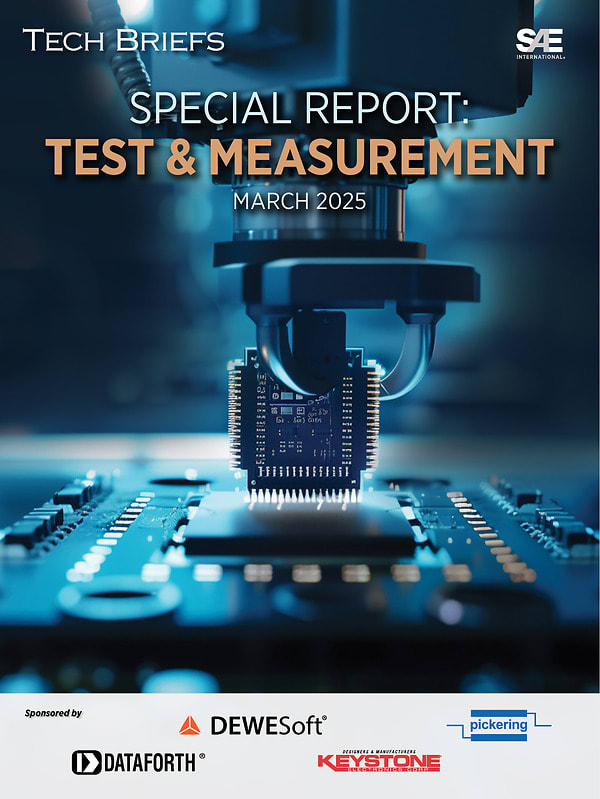
Testing the “eyes” of NASA's next space telescope…mass‐manufacturing photonic sensors at the quantum limit…driving zero defects in today's intelligent vehicles. Read about these and other applications in a new report from the editors of Tech Briefs and Aerospace & Defense Technology.
Don't have an account?
Overview
The "Test & Measurement Special Report" from March 2025 presents a comprehensive overview of significant advancements in technology and engineering, focusing on various applications and innovations in the field. The report highlights several key features, tech briefs, and white papers that showcase the latest developments in test and measurement technologies.
One of the standout features is the article on designing and testing the optics for NASA’s Nancy Grace Roman Space Telescope. This telescope is poised to enhance our understanding of the universe, and the meticulous design and testing of its optical components are crucial for its success.
Another significant topic covered is the push for zero defects in the automotive industry, particularly in the context of intelligent vehicles. The report discusses how semiconductor technology has evolved dramatically, with Nvidia's latest chip boasting 208 billion transistors. As the automotive market increasingly relies on these complex electronic components, the industry is now measuring defects in parts per billion (ppb), a stark contrast to the previous standard of parts per million (ppm). This shift is driven by the fact that over 50% of vehicle recalls are linked to electronic component failures, prompting manufacturers to adopt stringent quality control measures.
The report also delves into the realm of hypersonic testing, detailing the acquisition and telemetering of test data from hypersonic platforms. This area of research is critical for advancing aerospace technologies and ensuring the safety and reliability of high-speed vehicles.
In addition to these features, the report includes tech briefs that cover a range of topics. One notable brief discusses the detection of additive manufacturing defects in real time, which is essential for maintaining quality in 3D printing processes. Another highlights the advancements in quantum sensing, particularly in engineering photonic sensors that could lead to improved greenhouse gas and cancer detection capabilities.
The report also mentions the completion of the first phase of an atomic fountain project aimed at research in quantum sensing, indicating ongoing efforts to push the boundaries of measurement science.
Furthermore, the white papers included in the report provide insights into specific technologies, such as battery management systems and tweezer LCR-meter technology for precise measurements. These papers serve as valuable resources for professionals looking to enhance their understanding of emerging technologies and their applications.
Overall, the "Test & Measurement Special Report" serves as a vital resource for engineers, researchers, and industry professionals, offering a glimpse into the future of measurement technologies and their implications across various sectors. The report emphasizes the importance of innovation and quality control in an increasingly complex technological landscape, underscoring the critical role that test and measurement play in ensuring the reliability and performance of modern systems.










