

Power Electronics - April 2025
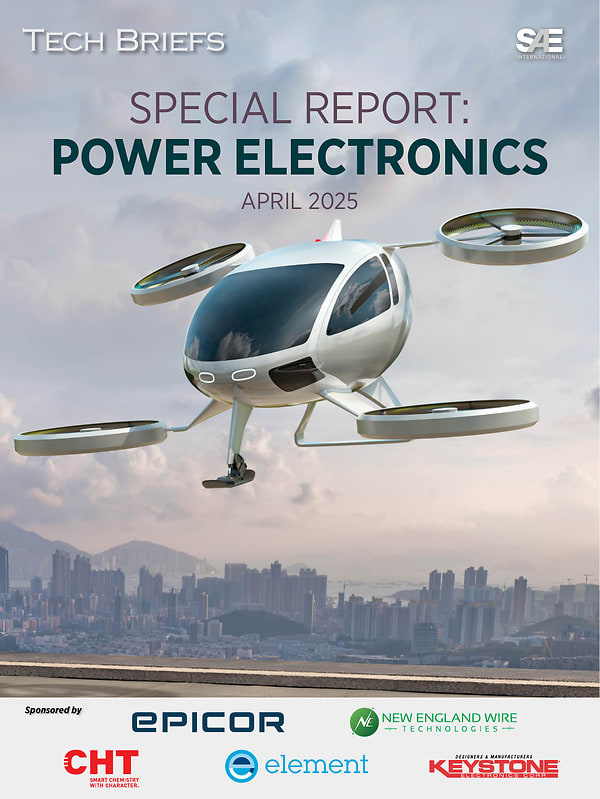
This compendium of articles from the editors of Tech Briefs and Aerospace & Defense Technology magazines looks at the latest advances in power electronics and energy storage for applications ranging from electric vehicles to advanced aircraft and space systems.
Don't have an account?
Overview
The "Power Electronics Special Report" from April 2025 presents a comprehensive overview of the latest advancements and technologies in the field of power electronics, particularly focusing on their applications in manufacturing and energy solutions.
One of the key highlights of the report is the importance of modern cloud Enterprise Resource Planning (ERP) systems for electronics manufacturers. The report emphasizes that in the fast-paced electronics industry, where product lifecycles are often under six months, manufacturers must optimize their planning, production, purchasing, sales, and after-sales processes. A cloud ERP system, such as Epicor Kinetic, is presented as a critical tool for achieving leaner and more agile operations. It offers comprehensive inventory management, enabling precise stock control and minimal waste, while also facilitating forecasting and master production scheduling (MPS) to keep manufacturers ahead of market demands. The integration of workflows and real-time data insights allows for swift responses to changes in customer needs and market conditions. Additionally, the report discusses the significance of quality checks and compliance in highly regulated industries, highlighting how automation can help maintain product quality and adherence to international standards.
The report also delves into cutting-edge technologies in energy and battery systems. One feature discusses the development of high-temperature superconducting (HTS) wires, which have the potential to revolutionize the electric grid and enable commercial nuclear fusion. Researchers from the University at Buffalo have made strides in fabricating high-performing HTS wire segments, aiming to achieve a price-performance metric comparable to traditional copper wires. This advancement could pave the way for large-scale applications of HTS technology.
Another significant topic covered is the innovation in battery technology, particularly the use of all-solid-state polymer electrolytes in batteries. This new approach addresses safety concerns associated with liquid electrolytes, which can be flammable and hazardous at high temperatures. The report highlights the potential of these solid-state batteries to enhance safety and performance in various applications.
The report also touches on the advancements in lithium metal batteries, which are being crafted for high-temperature environments, and the incorporation of silicon anodes in next-generation batteries. These developments are crucial for improving energy density and overall battery performance.
In addition to technological advancements, the report includes a section on the inter-relationships between technology and society, exploring how innovations in power electronics can deliver positive impacts in the face of social and environmental challenges.
Overall, the "Power Electronics Special Report" serves as a valuable resource for industry professionals, providing insights into the latest trends, technologies, and strategies that are shaping the future of electronics manufacturing and energy solutions. It underscores the critical role of modern ERP systems and innovative technologies in driving efficiency, safety, and sustainability in the rapidly evolving landscape of power electronics.











