

Sound can do more than just provide a nice beat. Sound waves have been used for everything from mapping the seafloor to breaking apart kidney stones. Thanks to a unique material structure, researchers can now move and position objects underwater without ever touching them directly. The work has been done by Dajun Zhang, a doctoral student at the University of Wisconsin-Madison.
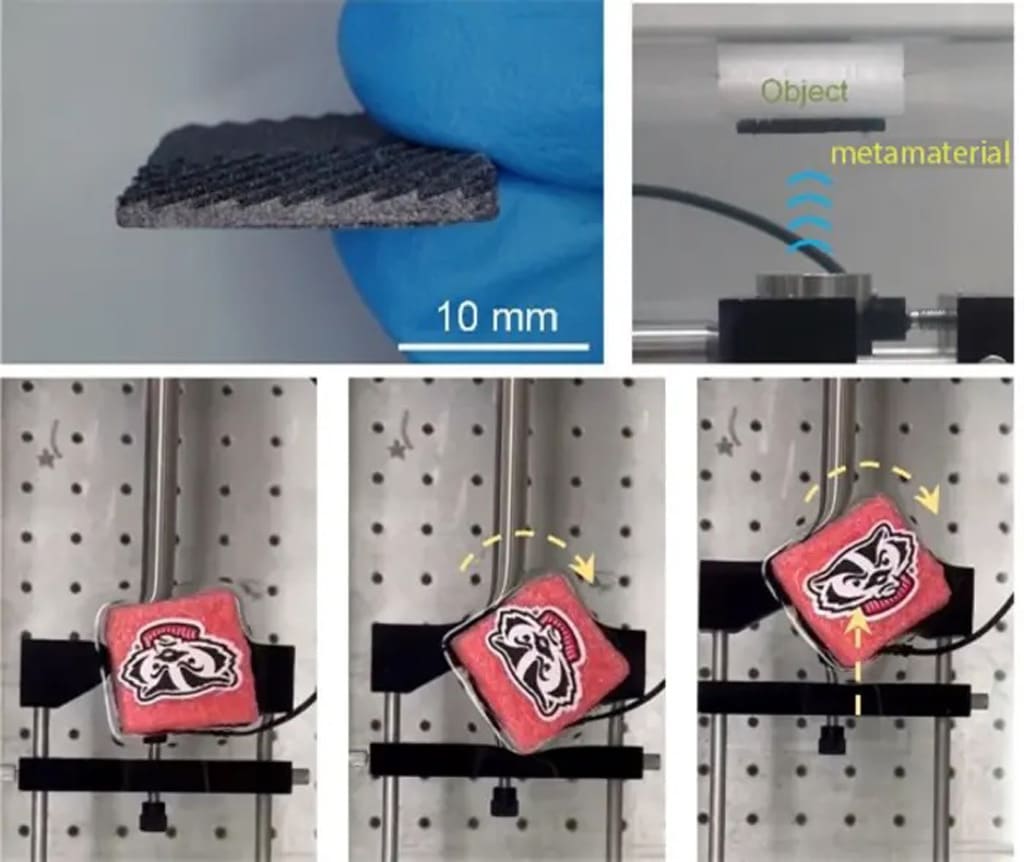
A metamaterial is a composite material that exhibits unique properties due to its structure. Zhang’s metamaterial features a small sawtooth pattern on its surface, which allows adjacent speakers to exert different forces on the material based on how the sound waves reflect off it. By carefully targeting the floating or submerged metamaterial with precise sound waves, Zhang can push and rotate any object attached to it exactly as much as he wants.
Manipulating objects in water without touching them could make a lot of underwater work easier. It could also be used inside the human body, which is mostly water, for applications like remote surgery or drug delivery.
“Our metamaterial offers a method to apply different acoustic radiation forces on objects in liquid media, such as underwater robots and vehicles, parts for assembly, or medical devices and drugs,” said Zhang.
However, manufacturing underwater metamaterials with the correct properties for object manipulation is difficult, especially with conventional methods.
“Current fabrication methods for underwater metamaterials do not provide the resolution or material properties required and are usually very expensive,” said Zhang. “To solve this issue, I developed a new fabrication method. This method is not only low cost and easy to implement but also achieves high fabrication resolution and large acoustic impedance contrast with water, which are keys to underwater metamaterials.”
In tests, Zhang used his metamaterial to manipulate floating objects, such as wood, wax, and plastic foam, along with objects completely submerged underwater. He attached his metamaterial to each object and used acoustic waves to push, pull, and rotate them. With submerged objects, this technique gave him the ability to manipulate them in three dimensions.
Zhang plans to continue his work, developing a metamaterial patch that is smaller and more flexible. He hopes his work will lead to new uses in medicine and underwater robotics.











