

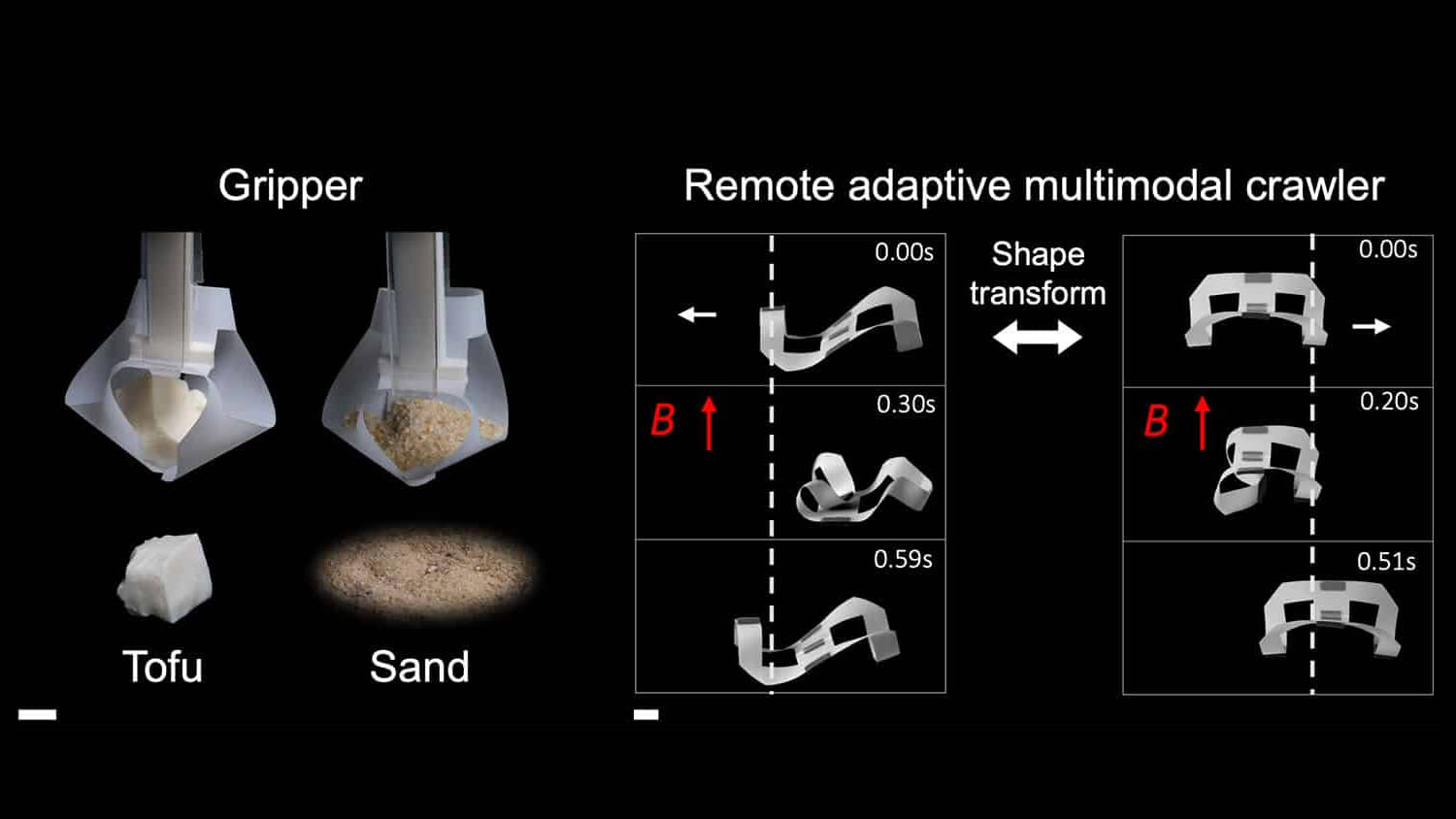
Researchers have created a class of robots made from thin sheets of material that can snap into hundreds of stable shapes — allowing them to execute a wide variety of actions despite not having a motor. They resemble animated sheets of plastic, capable of moving around a surface or grasping objects.
“We start out with simple polymer sheets that have holes in them, and by applying thin films to the surface of the polymer we’re able to incorporate materials that respond to electricity or magnetic fields,” said Jie Yin, corresponding author of a paper on the work and a professor of mechanical and aerospace engineering at North Carolina State University. “These films serve as actuators, allowing us to change the shape of the sheet remotely.”
“By connecting multiple sheets, we create structures that initially lie flat but can then bend and fold themselves into a wide variety of stable configurations,” said Caizhi Zhou, first author of the paper and a Ph.D. student at NC State. “For example, if we connect four sheets, you have a metabot that can lie as flat as a sheet of paper, but fold into 256 different stable states.” The flat robots have multiple modes of movement, capable of jumping or crawling at multiple speeds.
“The robots can change their shape and gait to adapt to different terrains or to perform a variety of functions, such as gripping and lifting objects,” said Zhou. “And when we incorporate piezoelectric materials into the thin films, we can cause controlled vibrations in the metabots by varying the voltage and frequency, giving us additional control over their movement. For example, we can have a metabot rotate left or right while staying in one place.”
“This is early-stage, proof of concept work, but it demonstrates that this approach to robotics is both inexpensive and highly adaptable,” said Yin. “Our goal was to bridge metamaterials and robotics, and we think the results are promising.”
Transcript
No transcript is available for this video.











