

Space Technology - May 2025
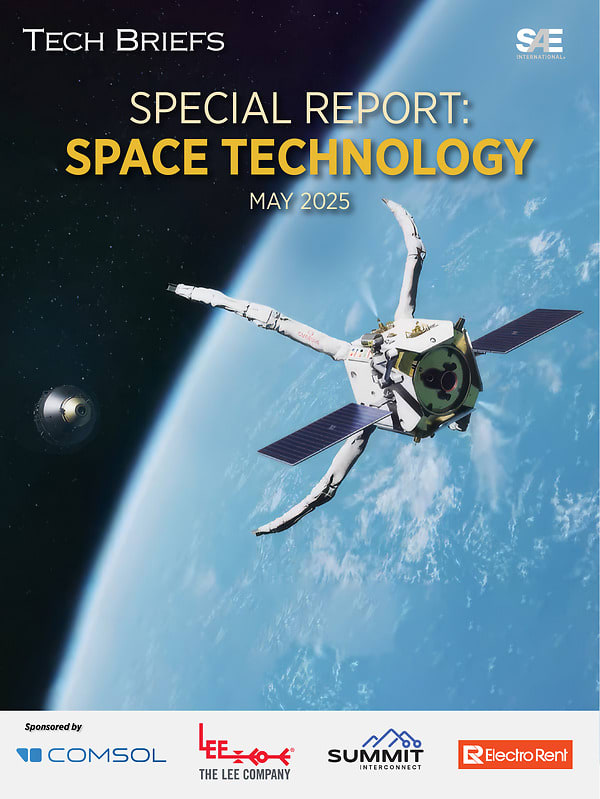
Seven space start‐ups you should know…how to machine complex parts for space flight…advanced sensors monitor motion on Martian moon rover. Read these stories and more in this compendium of articles from the editors of Tech Briefs and Aerospace & Defense Technology.
Don't have an account?
Overview
The May 2025 Special Report on Space Technology presents a comprehensive overview of recent advancements and innovations in the field of space exploration and sustainability. The report emphasizes the critical importance of thermal management in spacecraft, which is essential for ensuring astronaut safety, maintaining optimal performance of onboard systems, preventing material degradation, and protecting the structural integrity of spacecraft against extreme temperature fluctuations.
One of the key highlights of the report is the exploration of design trade studies aimed at optimizing spacecraft components. The team investigated various options, such as internal versus external heaters and aluminum beds versus vapor chambers, to achieve rapid and uniform heating during ramp-up phases. This focus on thermal management is crucial for the success of space missions, where temperature control can significantly impact mission outcomes.
The report also delves into the role of NASA’s Glenn Research Center in the development of ion thrusters, which are vital for the agency's science missions, including the Dawn and DART missions. Orbion, a company focused on advancing ion thruster technology, has entered into a Data Usage Agreement with NASA to leverage insights from the agency's materials research and innovations, such as a cathode heater that enhances electrical efficiency and extends the operating life of thrusters.
In addition to thermal management and propulsion technologies, the report features a section on space sustainability, highlighting the emergence of startups dedicated to addressing the growing issue of space debris. Companies like ClearSpace are pioneering solutions for debris cleanup by utilizing advanced tracking technologies, including sensors, radar, and telescopes, to monitor and manage failed satellites.
The report also covers advancements in carbon dioxide removal technologies, which are essential for sustaining life in space. These innovations are critical for long-duration missions, where maintaining a breathable atmosphere is paramount. The development of such technologies not only benefits space missions but also has potential applications for improving life on Earth.
Furthermore, the report discusses the manufacturing of complex parts and materials for space flight and exploration, showcasing the importance of precision engineering in the production of spacecraft components. This section highlights the capabilities of various supporting space companies that contribute to the overall success of space missions by delivering tested and reliable parts.
Lastly, the report touches on the application of gyro sensors for monitoring motion on the Martian moon rover, illustrating the integration of advanced technologies in robotic exploration. It also mentions NASA's efforts in bioprinting artificial organs, which could have significant implications for both space missions and healthcare on Earth.
In summary, the May 2025 Special Report on Space Technology encapsulates the dynamic landscape of space exploration, emphasizing the importance of thermal management, innovative propulsion systems, sustainability efforts, and advanced manufacturing techniques. It showcases how these elements are interwoven to address the challenges of space missions and contribute to the future of human life both in space and on Earth.










