

3D Systems
Rockhill, SC
www.3dsystems.com
NASA Glenn Research Center
Cleveland, OH
www.nasa.gov/glenn/
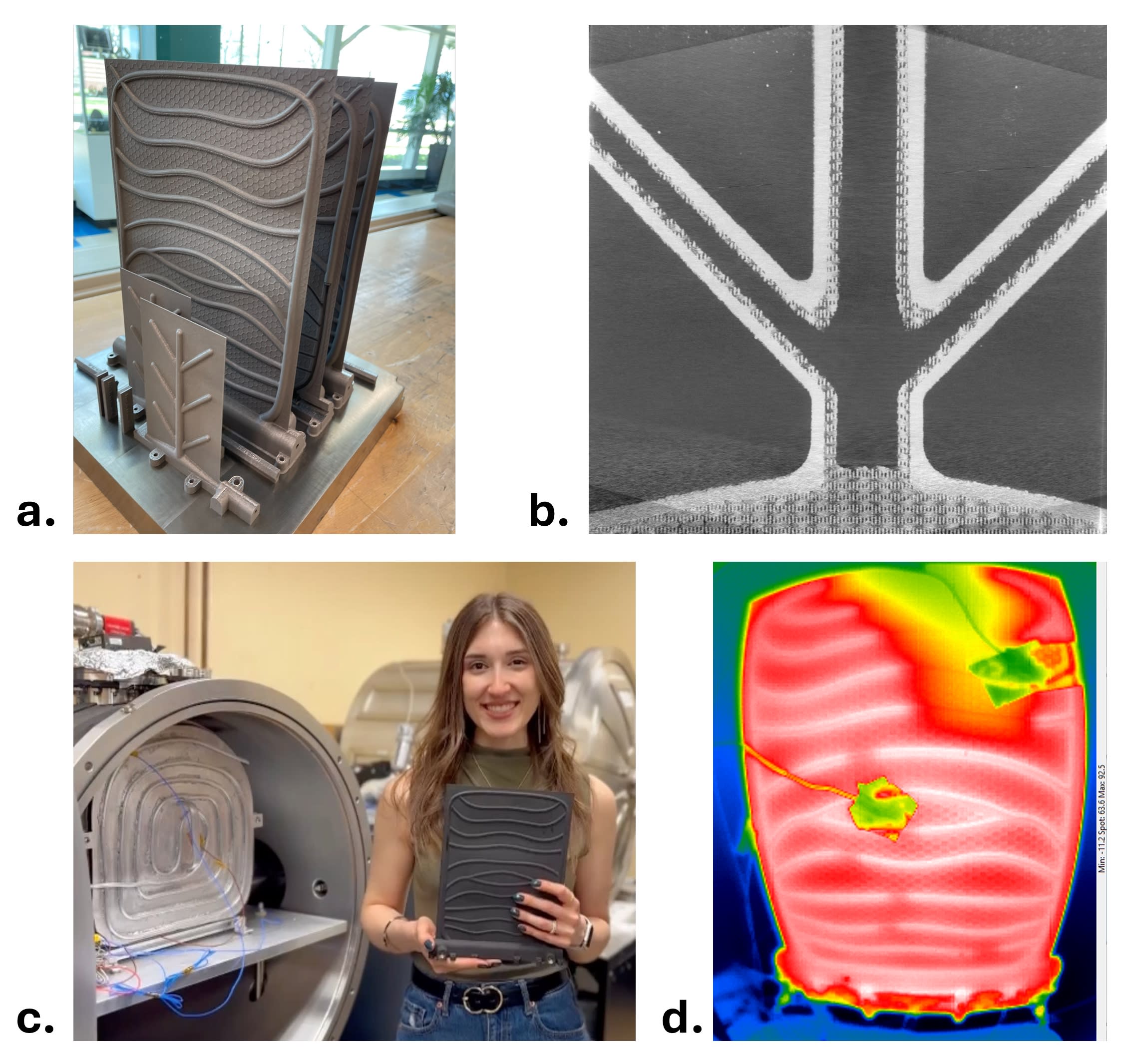
3D Systems is collaborating with researchers from Penn State University and Arizona State University on two projects sponsored by NASA intended to enable groundbreaking alternatives to current thermal management solutions.
Severe temperature fluctuations in space can damage sensitive spacecraft components, resulting in mission failure. By combining deep applications expertise with 3D Systems’ leading additive manufacturing solutions comprising Direct Metal Printing (DMP) technology and tailored materials and Oqton’s 3DXpert® software, the teams are engineering sophisticated thermal management solutions for the demands of next-generation satellites and space exploration.
The project led by researchers with Penn State University, Arizona State University, and the NASA Glenn Research Center in collaboration with 3D Systems’ Application Innovation Group (AIG) has resulted in processes to build embedded high-temperature passive heat pipes in heat rejection radiators that are additively manufactured in titanium. These heat pipe radiators are 50 percent lighter per area with increased operating temperatures compared with current state-of-the-art radiators, allowing them to radiate heat more efficiently for high-power systems.
Additionally, a project led by researchers at Penn State University and NASA Glenn Research Center with 3D Systems’ AIG yielded a process to additively manufacture one of the first functional parts using nickel titanium (nitinol) shape memory alloys that can be passively actuated and deployed when heated. This passive shape memory alloy (SMA) radiator is projected to yield a deployed-to-stowed area ratio that is 6× larger than currently available solutions, enabling future high-power communications and science missions in restricted CubeSat volume. When deployed on spacecraft, such as satellites, these radiators can raise operating power levels and reduce thermal stress on sensitive components, preventing failures and prolonging satellite lifespan.
Traditionally, heat pipes have been manufactured with complex processes to form porous internal wick structures that passively circulate fluid for efficient heat transfer. Using Oqton’s 3DXpert® software, the Penn State/Arizona State/NASA Glenn/3D Systems project team embedded an integral porous network within the walls of the heat pipes, avoiding subsequent manufacturing steps and resulting variability.
Monolithic heat pipe radiators were manufactured in titanium and nitinol on 3D Systems’ DMP technology. The titanium-water heat pipe radiator prototypes were successfully operated at temperatures of 230 °C and weigh 50 percent less (3 kg/m2 versus over 6 kg/m2), meeting NASA goals for heat transfer efficiency and reduced cost to launch for space-based applications (Figure 1).
The Penn State/NASA Glenn/3D Systems team is also pushing the boundaries of what is possible with metal AM by developing a process to 3D print passively deployed radiators with shape memory alloys. The chemistry of these materials can be tuned to change shape with application of heat. SMAs can withstand repeated deformation cycles without fatigue and exhibit excellent stress recovery.
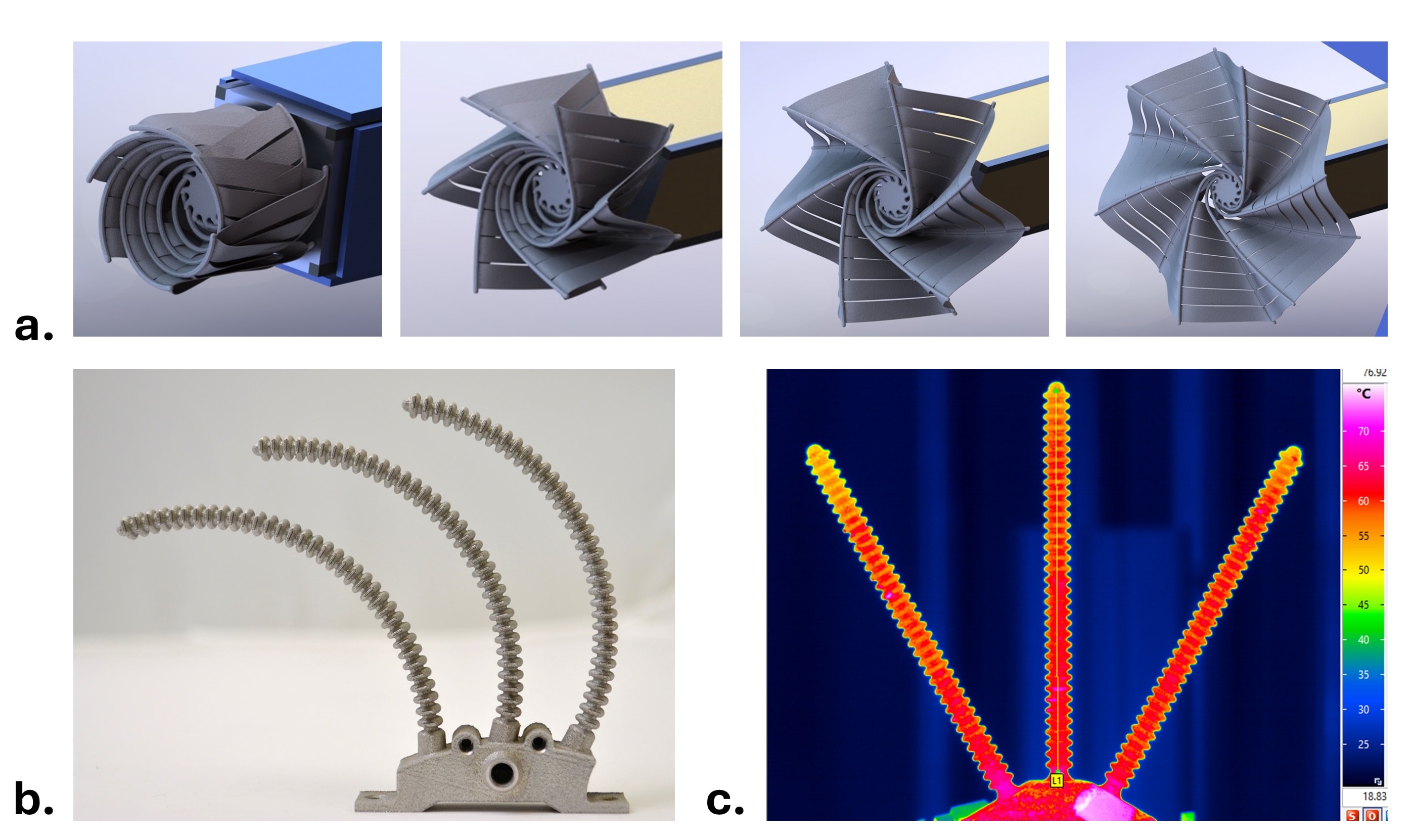
The team again used 3DXpert to design the deployable spoke structure of the radiator. This was then 3D printed in nitinol (NiTi), a nickel-titanium shape memory alloy, using 3D Systems’ DMP technology (Figure 2). When affixed to a spacecraft such as a satellite, this device can be passively actuated and deployed when heated by fluid inside, thus removing the need for motors or other conventional actuation in space. The passive shape memory alloy radiator developed by the team offers transformative advances with projected deployed-to-stowed area ratio that is 6× larger than what is currently considered state-of-the-art (12× versus 2×) and 70 percent lighter (<6 kg/m2 versus 19 kg/m2).
“Our long-standing R&D partnership with 3D Systems has enabled pioneering research for the use of 3D printing for aerospace applications,” said Alex Rattner, Associate Professor, The Pennsylvania State University. “The collective expertise in both aerospace engineering and additive manufacturing is allowing us to explore advanced design strategies that are pushing the boundaries of what is considered state-of-the-art. When we complement this with the software capabilities of 3DXpert as well as the low oxygen environment in 3D Systems’ DMP platform, we are able to produce novel parts in exotic materials that enable dramatically improved performance.”
“3D Systems has decades of leadership developing additive manufacturing solutions to transform the aerospace industry,” said Dr. Mike Shepard, Vice President, Aerospace & Defense, 3D Systems. “Thermal management in the space environment is an ideal application for our DMP technology. These latest projects, in collaboration with the teams at Penn State, Arizona State, and NASA Glenn Research Center, demonstrate the potential of our DMP technology to create lightweight, functional parts that advance the state-of-the-art in thermal management for spacecraft applications. Thermal management is an extremely common engineering challenge, and the DMP process can deliver solutions that are effective for many industries including aerospace, automotive, and high-performance computing/AI data centers.”
Additive manufacturing is making a significant impact by enabling the production of airworthy parts with reduced weight and improved performance. In the last decade alone, 3D Systems has worked alongside aerospace industry leaders to produce more than 2,000 structural titanium or aluminium alloy components for space flight, and over 200 critical passive RF flight parts. There are currently more than 15 satellites in orbit with 3D Systems-produced flight hardware on board.
This article was contributed by 3D Systems (Rockhill, SC). For more information, visit here .











