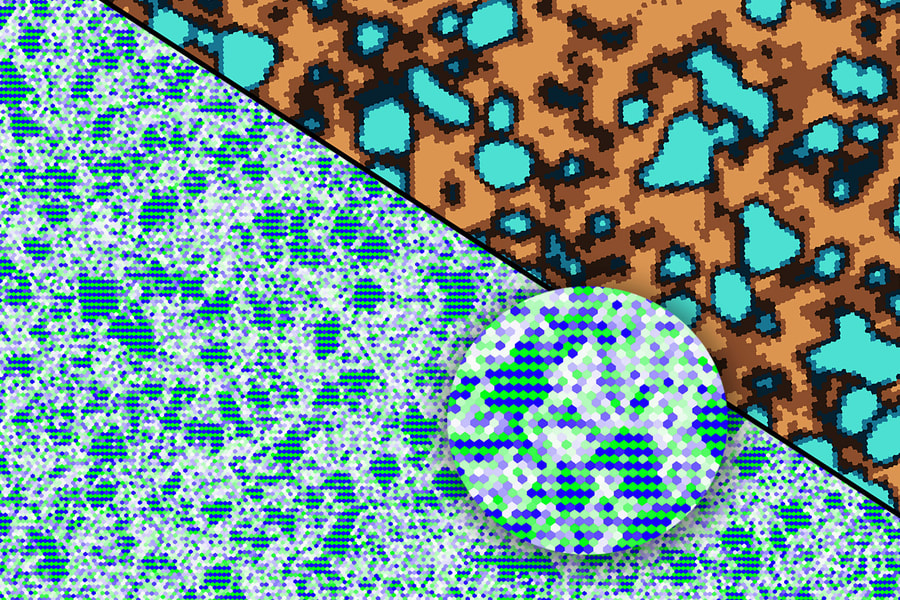
MIT engineers have developed a printable aluminum alloy that can withstand high temperatures and is five times stronger than traditionally manufactured aluminum.
The new printable metal is made from a mix of aluminum and other elements that the team identified using a combination of simulations and machine learning, which significantly pruned the number of possible combinations of materials to search through. While traditional methods would require simulating over one million possible combinations of materials, the team’s new machine learning-based approach needed only to evaluate 40 possible compositions before identifying an ideal mix for a high-strength, printable aluminum alloy.
When they printed the alloy and tested the resulting material, the team confirmed that, as predicted, the aluminum alloy was as strong as the strongest aluminum alloys that are manufactured today using traditional casting methods.
The researchers envision that the new printable aluminum could be made into stronger, more lightweight and temperature-resistant products, such as fan blades in jet engines. Fan blades are traditionally cast from titanium — a material that is more than 50 percent heavier and up to 10 times costlier than aluminum — or made from advanced composites.
“If we can use lighter, high-strength material, this would save a considerable amount of energy for the transportation industry,” says Mohadeseh Taheri-Mousavi, who led the work as a postdoc at MIT and is now an assistant professor at Carnegie Mellon University.
Here is an exclusive Tech Briefs interview, edited for length and clarity, with Taheri-Mousavi.
Tech Briefs: What was the biggest technical challenge you faced while 3D printing this aluminum alloy?
Taheri-Mousavi: In terms of research in additive manufacturing, the usual bottleneck is getting the custom powder. The main problem is that if you contact Carpenter Additive or any other powder company, they tell you they will give you at least 20- or 30-kilograms of powder. That’s a lot of powder. But then we found the Polish company Amazemet, who offered to do it for us for free. This is the only company that has a machine that can give you between 3- to 5-kilograms of powder, which is research-scale.
Tech Briefs: Can you explain in simple terms how you 3D print it? Is it just like any other 3D-printing task or is there a difference?
Taheri-Mousavi: We used LPDF, laser powder bed fusion. Now we have industry interest, and they are also considering faster manufacturing techniques like wire-based printing —they want higher throughput.
Tech Briefs: Do you have any updates you can share?
Taheri-Mousavi: We redesigned the alloy to increase ductility by 19 percent and only sacrificed 25 percent in strength. We wrote this up in a paper in nature partner journal advanced manufacturing. This is a really good alloy. If somebody wants to use it for a real application, they will need some ductility.
One car company asked us, ‘Can you consider cost and sustainability metrics of elements in your design?’ So, they asked us if we could redesign the alloy, and achieve the same properties, but with elements having lower cost or sustainability metrics? We redesigned the alloy computationally, and our first experiment was successful. The numerical design of that has been published, but the experimental design has not.
Tech Briefs: Those are all the questions I have. Is there anything else you'd like to add that I didn't touch upon?
Taheri-Mousavi: One thing that is interesting from my point of view is our numerical methods. The previous alloy from this Aluminum system was previously designed by experts who were doing alloy design for 40 or 50 years. When I joined the club, even though I was not an expert alloy designer, I was good with machine learning techniques. I was able to use my machine learning knowledge to improve their alloy.