

Aerospace Manufacturing - September 2025
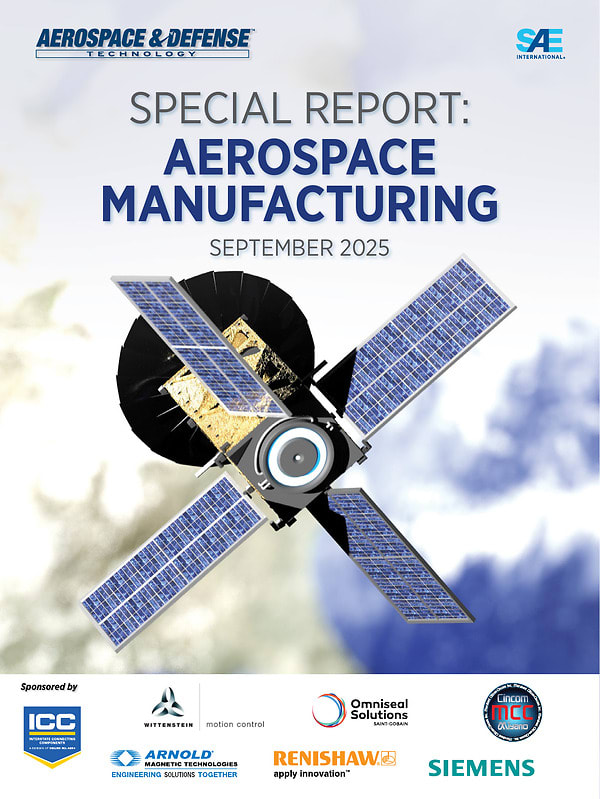
See the future of aerospace and defense manufacturing in this compendium of articles from the editors of Tech Briefs and Aerospace & Defense Technology magazines.
Don't have an account?
Overview
The September 2025 Aerospace Manufacturing Special Report focuses on the evolving landscape of aerospace manufacturing, emphasizing the critical role of advanced technologies in enhancing defense readiness and operational capabilities. The report highlights the shift in perception of additive manufacturing (AM) from a niche technology to an operational necessity for the defense sector. As geopolitical tensions rise and supply chains become increasingly fragile, the ability to produce essential defense components quickly and securely is deemed a strategic advantage. The report argues that the U.S. must strengthen its manufacturing base and reduce dependence on foreign supply chains to maintain its defense capabilities.
The document outlines how AM has transitioned from being primarily a prototyping tool to a vital production solution that supports the defense industrial base. It stresses the importance of integrating government policies with private sector innovation to bolster supply chains and ensure the U.S. can meet its defense needs even in times of crisis.
Additionally, the report features NearSpace Launch Inc. (NSL), a company that is redefining responsive spaceflight through its Train Rapid on Orbit Payload (TROOP) and ThinSat platforms. These platforms are designed to provide rapid, reliable, and affordable access to space for various applications, including technology demonstration and environmental sensing. NSL's commitment to communication reliability is highlighted, showcasing its success in achieving a 100% success rate for flight-verified radio systems, which are crucial for mission oversight and operational flexibility.
The report also touches on the historical context of aerospace manufacturing, noting that for the first century of flight, aircraft were primarily built by hand due to low production volumes. This has changed with advancements in technology, allowing for more automated and efficient manufacturing processes.
Overall, the report emphasizes the need for the U.S. aerospace sector to embrace advanced manufacturing techniques, particularly AM, to ensure national security and competitiveness in the global market. It calls for a collaborative approach between government and industry to foster innovation and resilience in the face of evolving challenges in defense and aerospace.











