


Reliable seed germination and plant production requires an environment that is neither too dry nor too wet. PONDS was developed to improve water and nutrient delivery for plants grown on the International Space Station (ISS). The technology uses an innovative wicking material to passively link a water/nutrient reservoir to a growth cylinder where seeds are germinated and plants are produced. PONDS addresses limitations with existing ISS plant-production technology by providing consistent delivery of water/nutrients, improving oxygen transfer to plants, and allowing users to determine how much water is being applied.
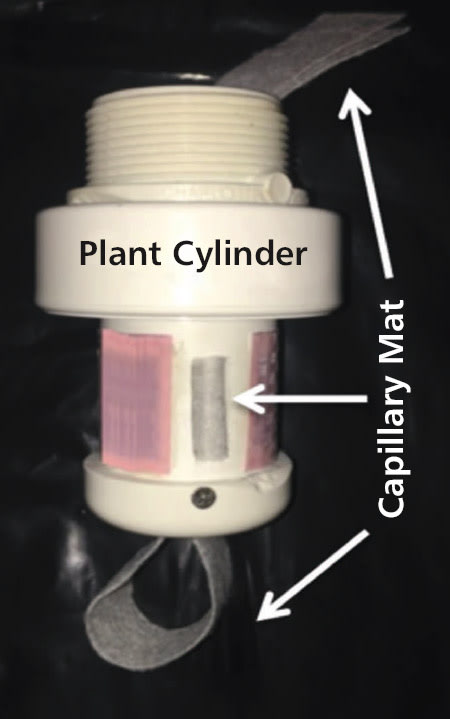
PONDS was developed as a water/nutrient delivery system for the Vegetable Production System, called VEGGIE, on the ISS. PONDS uses an innovative wicking material to passively link a water/nutrient reservoir to a plant cylinder. The system enables higher germination rates and improved growth conditions compared to the VEGGIE water/nutrient delivery system currently used on the ISS. PONDs consists of two primary components: a water/nutrient reservoir (Figure 1), and a detachable plant cylinder containing growth substrate and wicking material (Figure 2). The reservoir includes a viewing window that allows the user to observe and record water-use data. The plant cylinder, which screws into the reservoir system, is made from commercial-off-the-shelf materials and fittings.
Both the reservoir and plant cylinder include oxygen-permeable windows to enhance aeration to the root zone. Water is delivered from the reservoir to the substrate contained within the plant cylinder via the wicking material inserted into the growth substrate. The wicking material is intrinsically hydrophilic, providing improved capacity compared to the system previously used with VEGGIE. As a result, PONDS can continuously supply water to the root zone within the plant cylinder on demand.
NASA is actively seeking licensees to commercialize this technology. Please contact NASA’s Licensing Concierge at











