Space Technology - September 2025
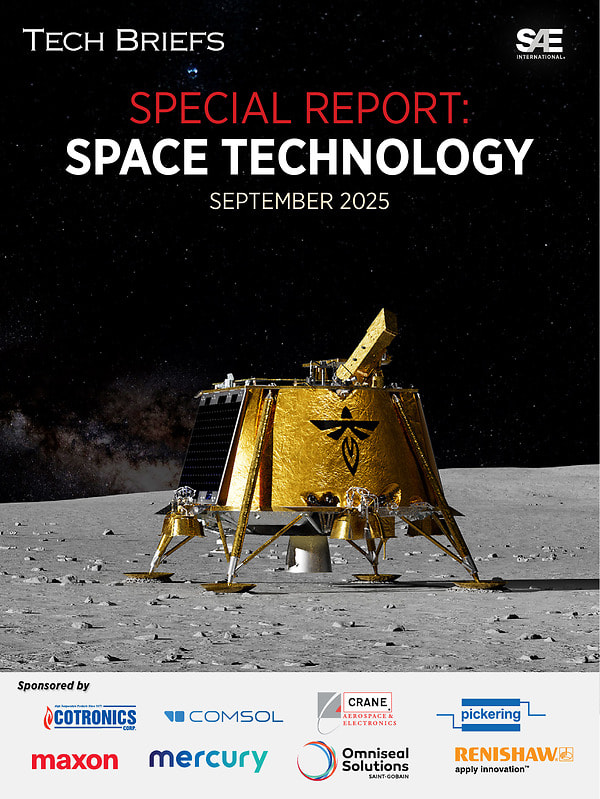
Blue Ghost, an historic lunar mission, is paving the way for future crewed endeavors and long‐term surface operations under NASA's Artemis campaign. Read about this and other recent advances in a compendium of space articles from the editors of Tech Briefs and Aerospace & Defense Technology.
Don't have an account?
Overview
The document is a Space Technology Special Report from September 2025, highlighting advancements and innovations in space technology, particularly focusing on optical communication, spacecraft power systems, and calibration technologies for satellite instruments.
One of the key topics discussed is the development of optical space communication systems that utilize lasers instead of traditional radio waves. This technology promises to significantly increase data transmission rates between spacecraft and from space to Earth, which is crucial for future missions to the Moon, Mars, and beyond. The report emphasizes the potential of overcoming technical challenges associated with optical systems to unlock a new era of space-based connectivity, enhancing the capabilities of data-collecting satellites.
Another significant advancement mentioned is the collaboration between the University of Leicester and NASA Glenn on a revolutionary spacecraft power system. This project combines electrically heated simulators of americium heat sources with Stirling power converter technologies. The collaboration, formalized through an International Space Act Agreement, aims to improve radioisotope power systems, which have been under development for over a decade with support from the European Space Agency’s ENDURE program. The successful testing of this power system marks a promising step forward for space exploration.
Additionally, the report discusses the ZONDA Hexapod, a smaller-scale hexapod designed for vacuum applications, specifically for the ground-based calibration and testing of the Interferometry Assembly Detection Electronics Assembly (IA DEA). This technology is crucial for the Infra-Red Sounder (IRS) instrument on sounding mission satellites, enabling in-flight characterization of optical and radiometric performance. The IRS is expected to provide valuable data for operational services in National Weather Centres and enhance global Numerical Weather Prediction.
Overall, the document underscores the importance of these technological advancements in enhancing space exploration capabilities, improving data transmission, and supporting scientific research. The innovations discussed are set to play a critical role in future missions, ensuring better connectivity and operational efficiency in the ever-evolving landscape of space technology.