

Automotive Test & Simulation - October 2025
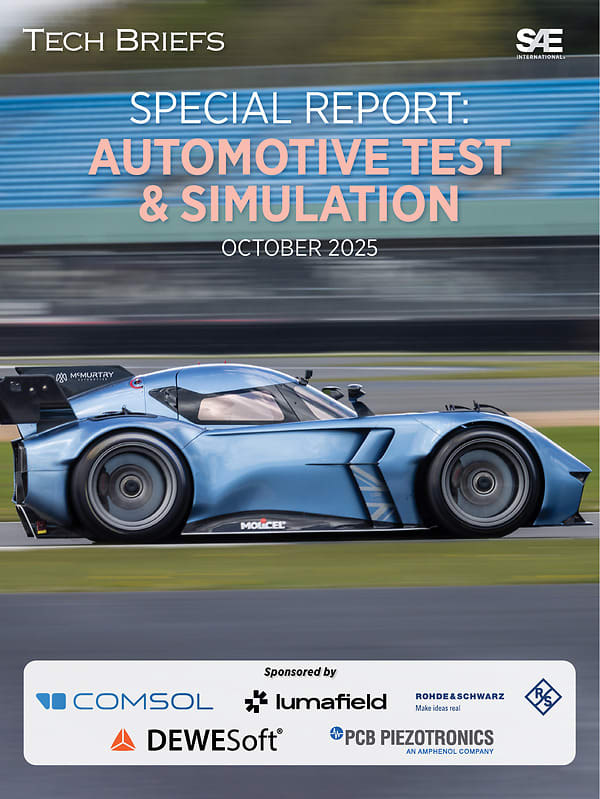
Benchmarking the impact of climatic conditions on EV charging times…how battery simulation is speeding EV development…a new standard for battery leak testing. Read about these and other developments in a compendium of articles from the editors of Automotive Engineering and Battery & Electrification Technology magazines.
Don't have an account?
Overview
The "Automotive Test & Simulation Special Report" from October 2025 focuses on the advancements in testing and simulation technologies for electric vehicles (EVs) and autonomous vehicles (AVs). As the automotive industry moves towards the commercial deployment of self-driving technology, the report highlights the challenges of validating these complex systems, particularly in ensuring safety and reliability across diverse real-world conditions.
A key initiative discussed is Project Certus, established in 2023 with funding from the Centre for Connected & Autonomous Vehicles. This project aims to enhance the effectiveness and depth of autonomous vehicle testing while adhering to rigorous safety standards. Led by HORIBA MIRA, the project collaborates with organizations such as Polestar, IPG Automotive, the Connected Places Catapult, and Coventry University. Certus focuses on improving the quantification of system performance and integrating this data into engineering decision-making, ultimately reducing development timelines and costs associated with deploying reliable AV technology.
The report emphasizes the limitations of traditional validation methods, which often rely on extensive scenario sampling. Unlike conventional vehicles, automated driving systems must demonstrate dependable performance across a highly variable operational design domain (ODD), which includes complex traffic patterns, varying weather conditions, and intricate driver interactions. This complexity makes it impractical to achieve meaningful test coverage through conventional means.
Additionally, the report discusses the importance of simulation in the development of battery systems for EVs. Engineers are increasingly using simulations to synchronize temperature and state of charge (SoC) to ensure that both parameters approach their operational thresholds simultaneously. This approach allows for greater confidence and precision during the development phase, reducing the risk of costly prototypes.
The report also touches on the testing of EVs under various climatic conditions, such as extreme temperatures, to assess their charging performance. By simulating worst-case scenarios, engineers can better understand how vehicles will perform in real-world situations.
Overall, the report underscores the critical role of advanced testing and simulation technologies in shaping the future of automotive design, enhancing performance, and ensuring the safety and reliability of both electric and autonomous vehicles.









