

ADAS/Connected & Automated Vehicles - December 2025
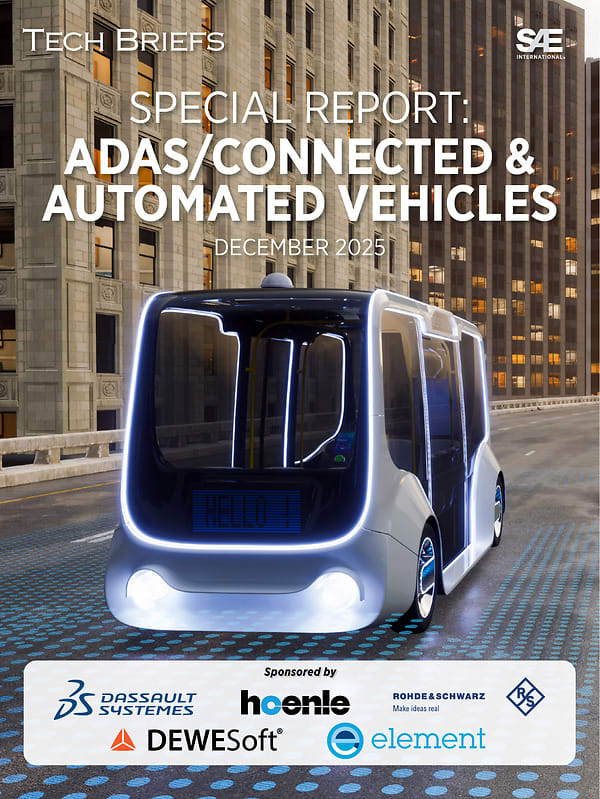
How the NVIDIA‐Magna collaboration is redefining autonomy…ultra‐realistic simulation speeds AV development…the 'autonomy underdogs' driving ADAS forward. Read about these and other new developments in this compendium of articles from the editors of Automotive Engineering and Truck & Off‐Highway Engineering.
Don't have an account?
Overview
This December 2025 special report on ADAS (Advanced Driver Assistance Systems), connected, and automated vehicles explores the accelerating trends, challenges, and innovations shaping the future of mobility. As vehicles assume greater responsibility for safety and decision-making, trust in their systems becomes paramount. The report highlights real-world incidents, such as Zoox’s recall due to unexpected braking and Cruise’s robotaxi pedestrian collision, emphasizing that system architecture and decision logic—not just sensor perception—are critical to building trustworthy automated vehicles.
A key focus is on the complexity of developing and validating ADAS and autonomous systems amid increasing regulatory scrutiny. Automakers face the challenge of proving that their systems perform reliably across a wide range of environmental conditions—different terrains, weather scenarios, lighting, and new infrastructure elements like updated traffic lights. This demands extensive testing, simulation, and verification to satisfy homologation requirements and to maintain safety standards even after vehicles are deployed on roads.
The report underscores industry priorities on accelerating development timelines without compromising quality. For example, some manufacturers have struggled with modifying supplier-provided ADAS components due to limited system understanding, leading to costly delays. By owning more of the development process and leveraging advanced simulation tools, OEMs seek to reduce engineering time and costs while ensuring robust system performance.
The transformative role of software in vehicle design is another major theme. SAE International’s Software-Defined Vehicles Summit—offered on-demand—addresses how electrification, AI, ADAS evolution, and connected vehicle technologies integrate to redefine vehicles as software-centric platforms. This software focus enables continuous functional updates throughout a vehicle’s lifecycle, supports cloud-native mobility solutions, and introduces new technology paradigms such as by-wire driving systems.
In summary, this report paints a comprehensive picture of the ADAS and automated vehicle landscape as it stands in 2025: marked by rapid technological innovation, stringent safety verification challenges, and an industry-wide pivot toward software-driven architectures that promise improved safety, adaptability, and customer value. However, it also cautions that trust is earned through resilient system design, thorough validation, and transparent operational reliability rather than sensational demonstrations.







