

Electric & Hybrid Vehicles - January 2026
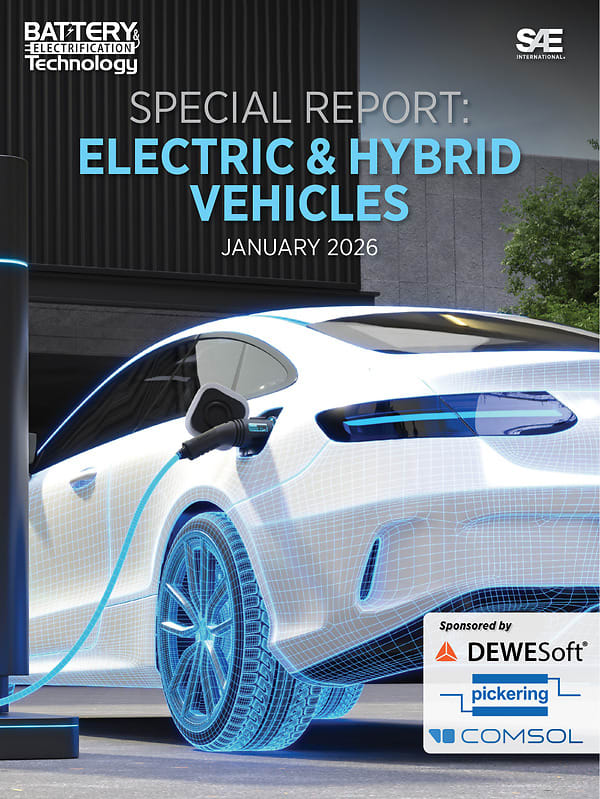
Engineering safer, more secure EV chargers…the future of radial flux motors for mobility platforms...why the EV market will overcome tax credit losses. Read about these and other developments in this compendium of articles from the editors of Automotive Engineering and Battery & Electrification Technology.
Don't have an account?
Overview
The January 2026 Electric & Hybrid Vehicles Special Report offers a comprehensive overview of the current state and future outlook of the EV industry, focusing on technological advancements, safety innovations, market trends, and manufacturing developments.
A significant focus is on improving EV battery safety, highlighting advanced silicone-based coatings and fiber-reinforced composite materials as superior alternatives to traditional mica sheets for battery pack enclosures. These new thermal and fire-resistant materials enhance mechanical durability, processability, and safety by resisting thermal runaway events, supporting automated high-volume production, and mitigating hazards from violent battery venting.
The report also emphasizes the evolving landscape of the U.S. EV market amid the phasing out of federal tax credits. Despite the removal of subsidies, the industry’s foundation remains strong, backed by expanding infrastructure such as the rapid installation of public charging ports and workforce development programs. The U.S. EV market share is expected to more than double by 2030 due to decreasing battery costs, broader model availability, and regulatory support from local ordinances promoting EV readiness and fleet electrification.
Another technological highlight is FEV’s electrified planetary gearset (EPGS) architecture for off-highway vehicles, offering modularity and scalability that eases the transition from conventional drivetrains to electrified powertrains. This system allows downsizing of combustion engines and transmissions while enabling multiple drive modes—hybrid, full electric, or plug-in—thus reducing complexity and enhancing overall efficiency. The EPGS architecture supports regenerative braking and engine operation at optimal efficiency points, benefiting agricultural and industrial machine applications.
Safety and security innovations include Renault’s “Fireman Access” system that dramatically reduces the time to extinguish EV battery fires by allowing rapid water flooding through a special adhesive disc, and EVject, a system enabling drivers to quickly disconnect charging cables in emergencies without leaving the vehicle.
Overall, the report underscores that EVs are firmly entrenched as the future of transportation. Continued advancements in battery chemistry, manufacturing efficiency, safety technologies, and supportive policies collectively ensure that electrification will accelerate globally, driven by strong market demand, technological innovation, and strategic domestic investments especially in the U.S.











