

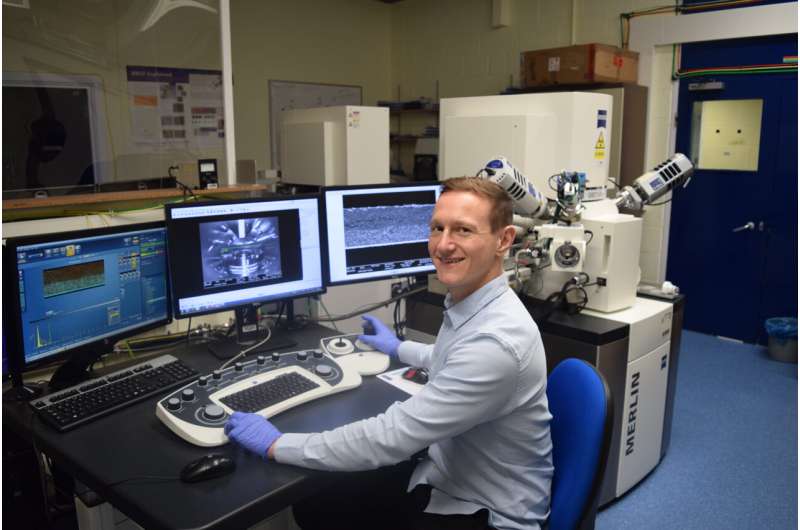
Researchers at the University of Oxford have developed a powerful new method to visualize an essential Li-ion battery electrode component that had been extremely difficult to trace before. The discovery, published in Nature Communications, could lead to increased manufacturing efficiency of battery electrodes and ultimately help improve the charging rate and lifetime of Li-ion batteries.
Lead Author Dr. Stanislaw Zankowski, Department of Materials, University of Oxford, said, “This staining technique opens up an entirely new toolbox for understanding how modern binders behave during electrode manufacturing. For the first time, we can accurately see the distribution of these binders not only generally (i.e., their thickness throughout the electrode), but also locally, as nanoscale binder layers and clusters, and correlate them with anode performance.”
Here is an exclusive Tech Briefs interview, edited for length and clarity, with Zankowski.
Tech Briefs: What was the biggest technical challenge you faced while developing the staining technique?
Zankowski: It was probably verifying the accuracy. That's something that may not be mentioned in our press releases, but the technique itself is not 100 percent new — there was another technique that was based on staining saturated polymers with something called osmium oxide. There were two problems with this technique: One is that it's one of the most toxic substances on Earth. Most labs are not allowed to work with it.
The other problem was that, from what I saw, there was not much focus on actually quantifying the accuracy of this method for analyzing the distribution of the binders. For example, in our early work we trialed copper instead of silver ions to stain CMC, but we found that copper changed distribution of the binder during staining, which is why it is so important to verify the accuracy of these staining methods. And that took us quite a few years to do.
Tech Briefs: Can you please explain in simple terms how the method works?
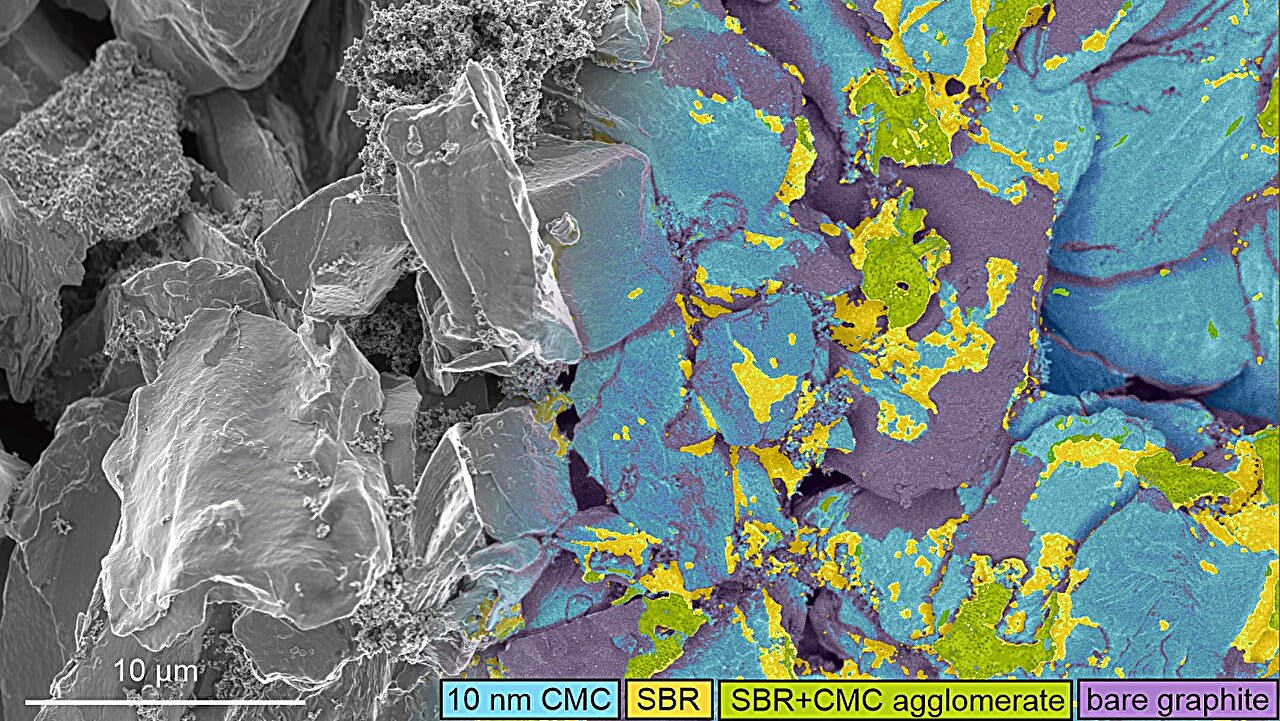
Zankowski: We take our electrodes that are already fabricated either in a lab or factory and we briefly expose them to the staining elements. We have either bromine that is going to stain the predominantly SBR, or silver that stains the CMC. For bromine staining, we put these electrodes in a small glass tube, and we basically create a vacuum in that vessel. Weprovide low vapor pressure of bromine vapors to that also. The bromine basically reacts with this unsaturated binder with the SBR, and then we remove the excess bromine and we have the bromine-stained SBR.
For silver staining, it's actually much simpler. We basically just take our electrode, we need to delaminate it from the current collector if the current collector is copper because silver will react with copper and we don't want that. Then we immerse it in a small glass beaker that contains a water solution of silver nitrate.
Generally speaking, you just dip it in, you leave it for three minutes. We also use a small peristaltic vacuum pump to make sure that all the liquid is penetrating throughout the electrode. After the three minutes, we take it out, we wash it with a lot of water, and that's it — it's already stained.
Tech Briefs: Do you have any set plans for further research, work, etc.?
Zankowski: Yes. One thing that we definitely want to do right now is verify the accuracy on polyacrylate -based binders. As you may know, especially for silicone electrodes, which are next-generation electrodes, polyacrylate has become a more and more attractive alternative to CMC. They provide a little bit better stability for these electrodes and also electrochemical stability. And we have already tested certain preliminary experiments where we saw that silver similarly stains the polyacrylate binders. And we were also able to do surface imaging of polyacrylate layers on carbon. But to be fully applicable, we need to verify the accuracy of the staining. So, we want to create electrodes with polyacrylic binders and verify that after silver staining we get the same distribution of silver.
The other development we want to do is to find a way that would not require us to delaminate the electrode from the copper current collector for CMC staining. As you can imagine, it's a little bit annoying and quite often impractical, especially when the electrodes are too thin. They're just very well adherent to the substrates. So, finding an alternative here is quite important.
Third thing that is very important from the perspective of industrial applications is to find an analysis method that doesn't require very lengthy cross sectioning of the sample. Currently, we are using argon plasma polishing, which takes around 10 hours per hundred-microns-thick sample, which is really excessive.
Tech Briefs: Is there anything else you'd like to add that I didn't touch upon?
Zankowski: I’m quite far from calling this a breakthrough; I would say this is an evolution of this research. There were already previous works that were looking at the earlier generation of binders, called PVDF, and they did have really accurate methods for finding them. What we are doing right now is one step forward. We are now saying, ‘OK, we acknowledge all the great stuff that has happened before, but we’re now working on a little different system.’ We have different polymers; they require a different type of analysis. Let's try to confirm where they are and see if some of the assumptions that were valid for those previous polymers are going to also be valid in this case. So, I see it really as an evolution, and I really want to acknowledge all the previous works that have happened.











