

Test & Measurement - November 2025
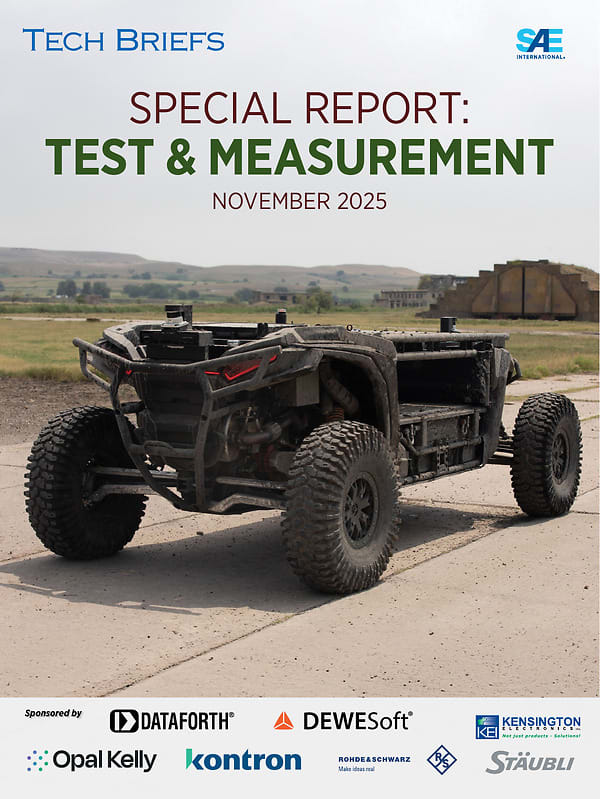
US Army tests innovative autonomous tactical vehicle...AI boosts super‐resolution microscopy…novel sensor enables ultra‐high temperature measurement. Read about these and other advances in this compendium of articles from the editors of Tech Briefs and Aerospace & Defense Technology.
Don't have an account?
Overview
The November 2025 Test & Measurement Special Report presents cutting-edge developments and practical insights across diverse technology domains, emphasizing innovation and application in structural testing, autonomous vehicles, advanced sensing, and precision instrumentation.
A central feature explores designing effective structural test programs, highlighting their role in validating complex systems like subsea drones engineered for harsh environments. The article underscores combining simulation with physical testing under realistic conditions—pressure, temperature, and corrosive exposure—to identify failure modes early and optimize designs. Thermal and battery-specific tests are integrated to ensure reliability over long missions, bolstered by experienced partners who understand nuanced test setups.
In innovation highlights, NASA introduces technologies advancing aerospace and industrial testing. This includes a pulsed light emitting diode (PLED) thermal inspection system improving defect detection on low-emissivity surfaces with higher contrast and reduced false readings, and a novel thin film temperature sensor designed to measure ultra-high temperatures (~1200 °F to ~3000 °F) on spacecraft surfaces during reentry with high-frequency response, overcoming limitations of traditional thermocouples.
The report also features U.S. Army’s evaluation of Overland AI’s ULTRA fully autonomous tactical vehicle, tested during the Agile Spirit 25 exercise. This all-wheel off-road robot combines AI for autonomous supply delivery, aiming to reduce soldier risk and enhance battlefield logistics. The ULTRA’s modular design supports diverse missions including casualty evacuation and counter-UAS operations, demonstrating a paradigm shift toward attritable, low-cost uncrewed systems.
Further coverage includes the German Aerospace Center’s (DLR) high-altitude solar-powered uncrewed aircraft HAP-alpha, recently passing critical ground vibration tests ahead of planned flights into the lower stratosphere for Earth observation and communications.
On the instrumentation front, Siborg Systems introduces tweezer-style LCR meters with proprietary open/short calibration boards that overcome parasitic effects in leads, enabling accurate measurements below 1 pF capacitance and 10 nH inductance. This innovation allows compact devices to rival more expensive benchtop meters in precision.
Additional briefs detail advances in super-resolution microscopy powered by AI, and embedded computing for industrial edge applications, reflecting ongoing integration of AI and robust hardware in test and measurement fields.
Overall, the report provides a comprehensive snapshot of how precision testing, innovative sensor technologies, and autonomous systems are converging to enhance reliability, safety, and operational capability across aerospace, defense, and industrial sectors.










