

There is increasing interest in lightweight and ultra-lightweight structural concepts and materials within NASA’s exploration mission and as part of efforts to develop “green” aeronautics options. Polymers and polymeric composites are important elements in design and construction of the nation’s future aircraft and spacecraft. Langley Research Center (LaRC) in particular has very active programs in development of advanced engineering polymers for use as structural components, as films or coatings, or for high-temperature or acoustic insulation.
NASA’s development efforts lead to invention of improved or new high-performance compositions each year, often involving polyimide monomers and other less common chemistries. The research often requires laboratory quantities of known, but not commonly available, monomers or derivatives of these compounds in 100-gram to kilogram quantities. A complete list of current monomer needs is available.
NASA Needs
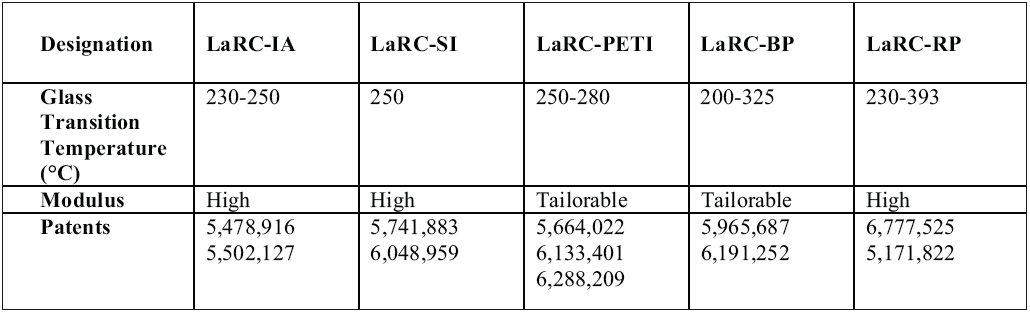
Some NASA-invented polymers have been licensed for certain fields of use, but many are not broadly available, even within NASA when large testing or demonstration efforts require kilogram or larger quantities. The same situation arises when potential industry or commercial product end-users need material for their own evaluation, since NASA is not a material supplier, except in very small quantities for scientific exchange purposes. We are therefore considering engaging one or more partners to provide relatively small quantities (100-g to 10-Kg) of our own polymer compositions for testing purposes internally to NASA, and for potential testing/use by other third-party end-users.
It is to everyone’s benefit if these high-performance materials find broader applications because of the cost savings associated with high-volume production. Examples of a few polymers are provided in the table, along with their related patents. A more complete list of potential polymers (and their properties) being considered for this program is available. By reviewing the patents, interested parties will have some idea of both the required monomers and the polymerization process/equipment required to produce them.
More Information
For further information, please contact R.P. Turcotte at











