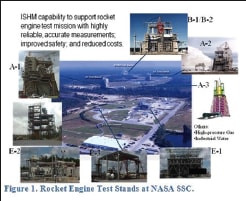
Stennis Space Center is NASA’s primary center for rocket engine testing. The facilities include large test stands built for the Apollo Program that are being used to test Space Shuttle Main Engines, smaller test stands for smaller rockets and components, and a new test stand, the A3 Test Stand with capability to simulate high-altitude conditions. All test stands are complex systems that provide oxidizer, fuel, and purge fluids, often at extreme pressures and high velocities. The test stand systems must also manage cryogenic temperatures from liquid oxygen, liquid hydrogen, and liquid nitrogen, as well as high temperatures from rocket plumes. Further more, test stands include hundreds of sensors, and accurate and reliable measurement systems to obtain data that can be used in the design, validation, and certification of engines and components.
Rocket engine testing is a complex and potentially hazardous operation, not unlike a spacecraft launch. Protocols and processes are followed in order to ensure readiness to test. In order to improve efficiencies and safety in test stand operations, it is crucial to develop systems that can help provide comprehensive and continuous vigilance of each element on the test stand. An ISHM system will provide this capability.
Technology Needs
The primary technologies that enable achievement of ISHM capability include:
- Algorithms/approaches/methodologies for anomaly detection.
- Approaches and methodologies for root-cause analysis to diagnose causes of anomalies.
- Approaches and methodologies for prediction of future anomalies.
- Architectures/taxonomies/ontologies that enable management of DIaK – where management implies distributed storage, sharing, processing, maintenance, configuration, and evolution.
- Software environments that integrate contributing technologies in a modular plug-and-play fashion, adhering to a defined architecture/ taxonomy/ontology.
- Standards that allow plug and play and interoperability among elements of an ISHM system.
- User interfaces to provide the user with integrated system awareness.
Developing solutions to the primary technologies must also consider intelligence and integration. In telligence implies that a credible ISHM capability that allows systematic augmentation of that capability must be a knowledgebased system. implies that inferences and decisions about the health of any element must incorporate and reason using other elements and physical phenomena through out the system.
More Information
For additional information, or to discuss ideas about this concept, contact John Lansaw of Stennis Space Center at 228-688- 1962 or visit