Software for decoding turbo codes that have been adopted as standard by the Consultative Committee for Space Data Systems is being developed along with hardware built around integrated-circuit digital signal processors (DSPs) that execute the software. The software enables reliable communication at data rates up to 700 kb/s at a signal-to-noise ratio (SNR) of –0.2 dB if a rate-1/6 code is used, or at an SNR of 0.8 dB if a rate-1/3 code is used. The software is written primarily in assembly language and runs on eight high-performance DSPs in parallel. Frames of data are distributed among six of the DSPs, which perform iterative decoding. A “stopping rule” is used to detect early convergence, thereby reducing the average number of iterations and, hence, increasing decoding speed. The remaining two DSPs perform ancillary functions, including frame synchronization, tracking of frame arrival times, de-randomization (sometimes used to ensure a bit-transition density sufficient for receiver tracking), and cyclic redundancy checking for verification of data.
This work was done by Kenneth Andrews; Valerie Stanton; Samuel Dolinar, Jr; Fabrizio Pollara; Jeff Berner; and Victor Chen of Caltech for NASA’s Jet Propulsion Laboratory.
This software is available for commercial licensing. Please contact Don Hart of the California Institute of Technology at (818) 393- 3425. Refer to NPO-30249.
This Brief includes a Technical Support Package (TSP).
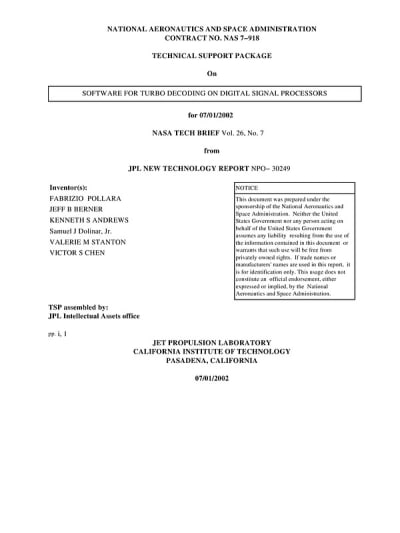
Software for Turbo Decoding on Digital Signal Processors
(reference NPO-30249) is currently available for download from the TSP library.
Don't have an account?
Overview
The document outlines the development of software for turbo decoding, a technology that enhances communication reliability in space applications. Turbo codes, first discovered in 1993 and adopted into Deep Space communication standards in 1999, are known for their superior performance and lower complexity compared to other coding methods. The software described is designed for use in the Deep Space Network (DSN) and was set to be installed at all DSN stations by October 2003.
The software operates on eight high-performance Texas Instruments TMS320C6201 Digital Signal Processors (DSPs). Six of these DSPs are dedicated to performing iterative decoding, while the remaining two handle ancillary functions such as frame synchronization, tracking frame arrival times, de-randomization, and cyclic redundancy check (CRC) verification. A key feature of the software is the "stopping rule" algorithm, which detects early convergence in the decoding process, thereby reducing the average number of iterations required and increasing the overall speed of the decoder.
The software is primarily written in hand-optimized assembly language, achieving data rates of up to 1 Mbps. It supports various turbo code rates, enabling reliable communication at data rates of up to 700 kb/s at a signal-to-noise ratio (SNR) of –0.2 dB for a rate-1/6 code, or at an SNR of 0.8 dB for a rate-1/3 code. This capability is crucial for maintaining effective communication in the challenging conditions of space.
The development team includes notable contributors from Caltech and NASA's Jet Propulsion Laboratory, such as Fabrizio Pollara, Jeff Berner, Kenneth Andrews, Samuel Dolinar, Valerie Stanton, and Victor Chen. The document also references the formal definition of the turbo codes supported, as outlined in the CCSDS Telemetry Channel Coding "Blue Book" standard.
The software is available for commercial licensing, and interested parties are directed to contact Don Hart at Caltech for further information. Overall, this document highlights significant advancements in turbo decoding technology, emphasizing its importance for future space missions and communication systems.