

The Gyroscope Automated Testbed is a computer-controlled apparatus designed primarily for automated testing of vibratory gyroscopes. It can also be used to test other devices: By changing testing-system/tested-device interface circuitry that is part of the apparatus, one can set up the apparatus to test nonvibratory gyroscopes. The apparatus can also be used as a general-purpose noise-analysis system for characterizing a variety of devices in addition to gyroscopes.
Heretofore, it has been necessary to resort to a manual process to test gyroscopes. The process is very time-consuming and requires expensive test equipment. The present apparatus automates most of the process for a fraction of the cost.

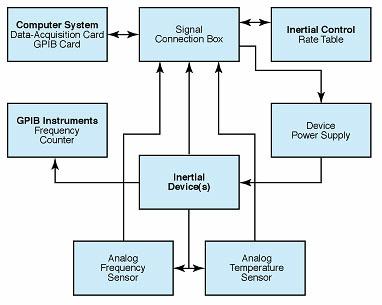
The apparatus (see Figure 1) is based on a Pentium II computer with a 16-bit data-acquisition card and a GPIB (general-purpose interface bus) interface card. Custom software for control of testing and analysis of data has been developed in Visual Basic. The system is fully automated and only requires an operator to initially set the desired testing conditions. The software can perform a rotational-response test, noise characterization test, and a power-cycle stability test. Data analysis is performed on the acquired data to characterize the rotational response and power-cycle stability (see Figure 2 on facing page). A Green chart and a plot of the power spectral density (PSD) are generated to characterize the noise properties of the device being tested. Device drift and Green charts can be corrected (linearized) by any other sampled data set (i.e., the drift data can be corrected for increasing temperature over the duration of a test). A report, which consolidates the results into a convenient document, is generated automatically upon completion of all tests. The software includes provisions for selecting the tests to be performed, setting test parameters, saving acquired data to a file, generating real-time output displays, testing under manual control, and deriving noise characteristics from previously acquired data.
This work was done by Christopher Evans and Roman Gutierrez of Caltech for NASA's Jet Propulsion Laboratory . For further information, access the Technical Support Package (TSP) free on-line at www.nasatech.com/tsp under the Test & Measurement category.
This software is available for commercial licensing. Please contact Don Hart of the California Institute of Technology at (818) 393-3425. Refer to NPO-20612.
This Brief includes a Technical Support Package (TSP).
Automated Apparatus for Testing Gyroscopes
(reference NPO-20612) is currently available for download from the TSP library.
Don't have an account?
Overview
The document outlines the development of an Automated Test System for Gyroscopes at NASA's Jet Propulsion Laboratory (JPL), aimed at enhancing the performance measurement and characterization of microgyroscopes during their development. The motivation behind this project stems from the need to streamline the testing process, which is traditionally time-consuming and requires significant operator intervention after each adjustment made during development. By automating this process, project members can focus more on research rather than testing.
The system is built around a standard Intel Pentium II computer and utilizes a National Instruments data acquisition card. Custom software, developed in Visual Basic, controls the system and analyzes the data collected during tests. The software is designed to perform rotational response tests and characterize noise through power spectral density (PSD) measurements. Upon completion of each test, a report is generated summarizing the results, which includes options for customizing test parameters, saving acquired data, and real-time output displays.
The document also details the user interface and system requirements for the application. It specifies that the application will operate on Windows 95/98 or Windows NT 4.0 (SP3) and requires a minimum of a Pentium II - 266 MHz processor, with recommended specifications for optimal performance. Memory requirements vary based on sampling rates, but should not exceed 128 MB for a single gyroscope acquisition. Additionally, a hard drive with at least 50 MB of space is necessary for application and system files, with more space required if data is saved to disk.
The primary users of this application are expected to have extensive knowledge of the testing procedures and hardware involved, ensuring a smooth transition to the new software. The document emphasizes that the application is designed to be user-friendly, similar in nature to existing systems, which should minimize difficulties for operators familiar with the testing environment.
Overall, this automated test system represents a significant advancement in gyroscope testing technology, promising to improve efficiency and accuracy while reducing the workload on researchers at JPL.







