

An air-displacement volumometer with soft sides has been devised for measuring the volume of a human body. This apparatus could be useful in hospitals, medical research laboratories, clinics, athletic facilities, and the like. It could also be used to measure the volumes of irregularly shaped objects with dimensions comparable to those of a human body.
The traditional procedure for measuring the volume of a human body is based on the Archimedean principle of weighing the subject in air, then weighing the subject underwater, then equating the volume of the subject to the volume of water displaced, as indicated by the difference between the two weight measurements. In this procedure, the subject is required to exhale totally, hold his or her breath, and submerge totally in water. The traditional procedure is obviously not suitable for subjects who are hydrophobic or averse to total exhalation.
The use of air-displacement volumometers does not involve immersion, and total exhalation is unnecessary. Air-displacement volumometers with hard sides were used during the early 1960s, but were abandoned because they gave relatively inaccurate results (±5 percent). Moreover, hard-sided air-displacement volumometers were large and not portable. The present soft-sided air-displacement volumometer gives relatively accurate results (±0.15 percent) and is portable.
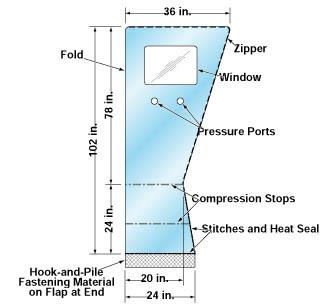
The soft-sided air-displacement volumometer consists mostly of a hermetic bag with pressure ports and a hermetically sealing zipper (see figure). The bag is also marked with two compression stops; these are lines to which the lower end of the bag is rolled to provide compression to a sequence of known volumes. The measurement procedure is as follows:
- The subject enters the bag, which is then zippered shut.
- The bag is inflated to a gauge pressure of 10 cm H2O (0.98 kPa).
- The subject is asked to hold his or her breath during the next step.
- The bag is rolled up to the first compression stop and held there momentarily, then rolled up to the second compression stop. The pressure is recorded continuously during this compression process.
- The subject is instructed to breathe.
- Steps 2 through 5 are repeated four more times to obtain a total of five trials, each involving a sequence of three pressure measurements (the initial inflation pressure and the pressures at the two compression stops).
Using the ideal-gas law, one calculates the volume of the person or irregular object in the bag from the nominal empty-bag volumes and corresponding pressure readings at initial inflation and the two compression stops for each trial. The calculated volumes are then averaged over the five trials. The results of these calculations are independent of the elasticity of the bag, provided that the elasticity of the bag remains constant over the small ranges of pressure and volumes used in the measurements.
This work was done by Steven F. Siconolfi of Johnson Space Center. For further information, access the Technical Support Package (TSP) free on-line at www.nasatech.com/tsp under the Mechanics category.
This invention has been patented by NASA (U.S. Patent No. 5,948,977). Inquiries concerning nonexclusive or exclusive license for its commercial development should be addressed to
the Patent Counsel
Johnson Space Center
(281) 483-0837.
Refer to MSC-22653.










