The Iterative Plan Optimization computer program automatically optimizes plans with respect to preferences expressed by human planners. This program incorporates a generalization of commonly occurring plan-quality metrics to provide a language for expression of preferences. The program implements a technique of iterative optimization that is a generalization of a prior technique of iterative repair, in which conflicts are detected and addressed one at a time until either no conflicts exist or a user-defined time limit has been exceeded. During iterative optimization, low-scoring preferences are detected and addressed individually until the maximum score is attained or until a user-defined time limit has been exceeded. A preference is a quality metric for a plan variable and can be improved by modifying the plan in a manner similar to that of repairing it. Plan modifications can include moving, creating, and deleting activities. For each preference, a domain-independent improvement-expert subprogram automatically generates the subset of modifications that could potentially improve the preference score.
This program was written by Steve Chien, Barbara Engelhardt, and Gregg Rabideau of Caltech for NASA's Jet Propulsion Laboratory. For further information, access the Technical Support Package (TSP) free on-line at www.nasatech.com/tsp under the Software category.
This software is available for commercial licensing. Please contact Don Hart of the California Institute of Technology at (818) 393-3425. Refer to NPO-20922.
This Brief includes a Technical Support Package (TSP).
Software for Iterative Optimization of Plans
(reference NPO-20922) is currently available for download from the TSP library.
Don't have an account?
Overview
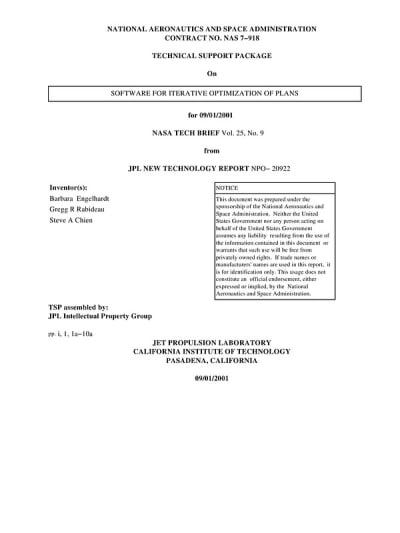
The document is a technical support package prepared by the Jet Propulsion Laboratory (JPL) under the sponsorship of the National Aeronautics and Space Administration (NASA). It focuses on a software system designed for the iterative optimization of plans, which is particularly relevant for complex decision-making scenarios in space exploration and other scientific endeavors.
The software aims to enhance the planning process by allowing human planners to articulate their preferences and priorities effectively. It employs advanced algorithms to analyze various planning scenarios, identify potential conflicts, and propose optimal solutions. This iterative approach enables continuous improvement of plans, ensuring that they adapt to changing circumstances and new information.
The document highlights the contributions of the inventors, Barbara Engelhardt, Gregg R. Rabideau, and Steve A. Chien, who have developed this innovative tool to support mission planning and execution. The software is designed to automatically utilize science opportunities, thereby maximizing the scientific return from missions while minimizing resource expenditure.
Additionally, the document includes a notice stating that the U.S. Government and its representatives do not assume liability for the use of the information contained within, nor do they guarantee that such use will be free from privately owned rights. This disclaimer emphasizes the importance of understanding the legal implications of using the software and the information provided.
The technical support package is part of NASA Tech Brief Vol. 25, No. 9, and is cataloged under JPL New Technology Report NPO-20922. It serves as a resource for researchers, engineers, and planners involved in space missions, providing insights into the capabilities and applications of the software.
Overall, this document represents a significant advancement in the field of automated planning and optimization, showcasing NASA's commitment to leveraging technology to enhance scientific exploration and discovery. The software's ability to facilitate better decision-making processes is crucial for the success of complex missions, making it a valuable asset for future endeavors in space exploration and beyond.