

Cube-shaped thermoelectric devices energized by a particles from radioactive decay of 244Cm have been proposed as long-lived sources of power. These power cubes are intended especially for incorporation into electronic circuits that must operate in dark, extremely cold locations (e.g., polar locations or deep underwater on Earth, or in deep interplanetary space). Unlike conventional radioisotope thermoelectric generators used heretofore as central power sources in some spacecraft, the proposed power cubes would be small enough (volumes would range between 0.1 and 0.2 cm3) to play the roles of batteries that are parts of, and dedicated to, individual electronic-circuit packages. Unlike electrochemical batteries, these power cubes would perform well at low temperatures. They would also last much longer: given that the half-life of 244Cm is 18 years, a power cube could remain adequate as a power source for years, depending on the power demand in its particular application.
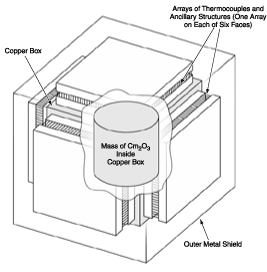
The cubical configuration of a proposed device of this type (see figure) would contribute to thermal efficiency by providing a relatively large area for rejection of heat at low temperature. It would also contribute to thermal-to-electrical energy-conversion efficiency by providing a relatively large heat-transfer area that could be covered with arrays of thermocouples and maximizing the temperature drop across the thermoelectric elements.
The geometric and thermal heart of a proposed thermoelectric power cube would be a cubic box, made of porous copper, that would enclose a mass of about 0.5 g of 244Cm in oxide form. The wall thickness of the box [Å20 mils (Å0.5 mm)] would be sufficient to stop the a particles and contain any ancillary radioactivity. The deposition of radioactive-decay energy in the walls of the box would generate heat at the rate of 4.2 W initially, falling to 2.1 W in 18 years. At the initial rate and under typical anticipated operating conditions, this heating would maintain the temperature of the box at about 200 °C.
Thin-film arrays of thermocouples would be mounted on all six faces of the box for efficient conversion of heat into electricity. The portion of the power cube described thus far would be enclosed in a layer of metal that would serve as both a shield and a heat-sinking interface with the environment. The metal shield would also help to contain small amounts of soft g radiation and neutrons that are emitted from the 244Cm along with the a particles.
According to first estimates, each face would be covered with about 50 thermocouples that would generate 40 mW of power (a potential of 2 V at a current of 20 mA). Hence, the total electric power produced would be 240 mW, corresponding to an overall thermal-to-electrical energy-conversion efficiency of between 5 and 6 percent.
A Power Cube according to the proposal would be designed to exploit synergies among small size, the cubical configuration, and low ambient temperature to obtain relatively high energy-conversion efficiency.
This work was done by Jagdish U. Patel, Jean-Pierre Fleurial, G. Jeffrey Snyder, and Thierry Caillat of Caltech for NASA's Jet Propulsion Laboratory. For further information, access the Technical Support Package (TSP) free on-line at www.techbriefs.com/tsp under the Physical Sciences category.
NPO-30328
This Brief includes a Technical Support Package (TSP).
Miniature Radioisotope Thermoelectric Power Cubes
(reference NPO-30328) is currently available for download from the TSP library.
Don't have an account?
Overview
The document presents a novel power generation technology developed for NASA applications, specifically focusing on a miniaturized thermoelectric power cube that operates efficiently in extreme low temperatures. This power cube, measuring between 0.1 to 0.2 cm³, generates an output of 200-400 milliwatts using the kinetic energy from alpha particles emitted by the radioactive isotope Californium-244 (Cm-244).
The primary motivation behind this technology is the need for long-lived, reliable power sources for deep space exploration missions, such as those targeting Mars, Europa, and Pluto. Traditional battery technologies are inadequate for these missions due to their limited operational life (200-250 hours) and inability to function below 200K. In contrast, the proposed power cube can operate effectively in temperatures ranging from 30K to 300K, with a lifespan of 15 to 40 years without the need for recharging.
The power cube's design incorporates three major components: heat generation, heat-to-electricity conversion, and heat rejection, along with radiation shielding. The device's high efficiency and specific power are achieved by using small amounts of radioisotope material, which increases the effective thermal surface area for thermal-to-electric conversion. This discrete formation allows for better heat rejection at lower temperatures, enhancing the overall performance of the device.
One of the key advantages of this technology is its ability to support distributed power applications. The miniaturized nature of the power cubes enables them to be mounted directly on electronic integrated circuits (ICs) and micro-electromechanical systems (MEMS), creating self-powered electronics. This eliminates the need for extensive cabling associated with centralized power systems, thereby reducing mass and complexity in space missions.
The document emphasizes the potential applications of these power cubes in various fields, including powering sensors, robotic systems, and underwater exploration devices. The technology is positioned as an enabling solution for long-duration missions, providing a sustainable and efficient power source in environments where traditional power systems fail.
In summary, the proposed alpha particle-based thermoelectric power cube represents a significant advancement in power generation technology for space exploration, offering a long-lasting, efficient, and miniaturized solution for powering electronic devices in extreme conditions.











