

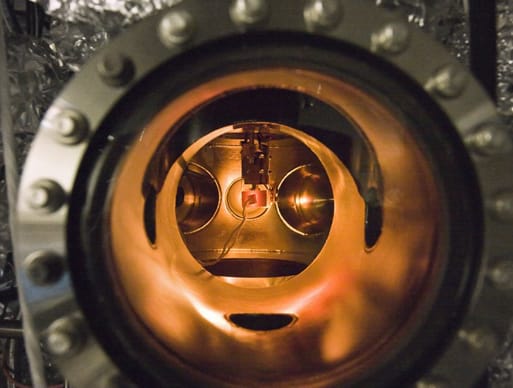
"This is really a conceptual breakthrough, a new energy conversion process, not just a new material or a slightly different tweak," said Nick Melosh, an assistant professor of materials science and engineering, who led the research group. "It is actually something fundamentally different about how you can harvest energy."
Melosh's group figured out that by coating a piece of semiconducting material with a thin layer of the metal cesium, it made the material able to use both light and heat to generate electricity. While most silicon solar cells have been rendered inert by the time the temperature reaches 100 °C, the PETE device doesn't hit peak efficiency until it is well over 200 °C. The team would like to design the devices so they could be easily bolted on to existing systems, thereby making conversion relatively inexpensive.
In the video below, Melosh describes how the system works from his Stanford lab.
Transcript
00:00:01 Stanford University the key to our thermal conversion process is that it uses both the energy from the light and from Heat at the same time so the higher temperature that you go the more energy that you have to convert actually and so you can actually get higher voltages out and more power this will actually seal
00:00:27 off um everything in there from what goes on in here so you can add your CH sample in here Pump It Down clean it out get it perfectly ready and so instead of just letting all the heat dissipate we actually ramp the device up to higher and higher temperature and then use that in our conversion process directly and then the waste heat also comes off at a higher temperature and so it's useful so
00:00:51 we can say the difference for our technology compared to regular solar cell technology is really the hotter the better and so as we heat up our device it becomes more and more efficient which allows us to go to very high temperatures convert efficiently and have that high temperature do useful work afterwards in the form of thermal processing and so we're thinking of the
00:01:13 implementation of these new devices is not just a standalone kind of device but actually as an add-on device to existing solar dish Technologies it's really um kind of a conceptual Revolution forward which will allow you to really really make solar energy cost competitive or level with hydrocarbon technology and at that point then you're no longer reliant on coal and oil and as we've seen with
00:01:41 the BP spill that's uh significant cost outside of just what you pay per barrel for more please visit us at stanford.edu










