

The term "common/dependent pressure vessel" (C/DPV) denotes a proposed alternative configuration for a nickel-hydrogen battery. The C/DPV configuration is so named because it is a hybrid of two prior configurations called "common pressure vessel" (CPV) and "dependent pressure vessel" (DPV). The C/DPV configuration has been proposed as a basis for designing highly reliable, long-life Ni/H2-batteries and cells for anticipated special applications in which it is expected that small charge capacities will suffice and sizes and weights must be minimized.
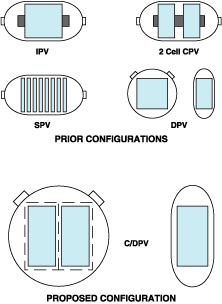
- A DPV has a pocket-watch shape that is both advantageous and disadvantageous, in comparison with the shapes of the IPV, CPV, and SPV. The advantage is that a battery or cell can be made relatively flat and thin to fit in a thin space; the disadvantage is that a pressure vessel of this shape is not self-supporting and therefore must be mounted between objects that restrain it. DPV cells have not been widely used.
- The SPV and CPV configurations have been the basis of the established method for designing pressure vessels containing multiple cells.
Like the CPV and SPV configurations, the C/DPV configuration is one of multiple cells contained within a DPV. This configuration would afford the advantages and disadvantages of the DPV configuration (thinness and the need for mechanical restraint, respectively), while making it possible to use an electrolyte-containment system like that of the SPV. Although it is not readily apparent by visual examination of the figure, calculations have shown that for a given small charge capacity, the volumetric efficiency of a battery in the C/DPV configuration would exceed the volumetric efficiencies of batteries in the other configurations mentioned. Other anticipated advantages of the C/DPV configuration include improved thermal properties, greater simplicity and reliability (in comparison with the SPV configuration), lower costs associated with the simpler designs, and amenability to replacement and matching of cells.
This work was done by Paul J. Timmerman of Caltech for NASA's Jet Propulsion Laboratory. For further information, access the Technical Support Package (TSP) free on-line at www.techbriefs.com/tsp under the Computers/Electronics category. NPO-20769.
This Brief includes a Technical Support Package (TSP).
Common/De[endent-Pressure-Vessel Nickel-Hydrogen Batteries
(reference NPO-20769) is currently available for download from the TSP library.
Don't have an account?
Overview
The document is a NASA Technical Support Package detailing advancements in Common/Dependent-Pressure-Vessel (C/DPV) Nickel-Hydrogen Batteries, developed by the Jet Propulsion Laboratory (JPL). It addresses the challenges of sizing nickel-hydrogen batteries for small spacecraft, emphasizing the need for a design that offers high specific volumetric efficiency and adaptability for low aspect ratio footprints.
The C/DPV configuration is a hybrid design that integrates features from existing battery configurations, specifically the Common Pressure Vessel (CPV) and Dependent Pressure Vessel (DPV) designs. The DPV is characterized by its pocket-watch shape, which allows for a flat and thin battery profile, making it suitable for constrained spaces. However, this shape also presents challenges, as the DPV is non-self-supporting and requires external support for structural integrity. The C/DPV aims to leverage the advantages of the DPV while incorporating the established methods of the CPV and Single Pressure Vessel (SPV) designs to contain multiple cells within a single pressure vessel.
The document highlights the benefits of the C/DPV configuration, including reduced parts count, simplified structures, improved thermal properties, and a more straightforward cell selection process. This design is particularly advantageous for future small explorer missions by NASA and JPL, where weight and space are critical factors.
Additionally, the document outlines the technical disclosure of the innovation, detailing the motivation behind the development of the C/DPV design. It addresses the limitations of existing battery technologies, which often do not provide the long life and high duty cycle capabilities required for space applications. The proposed solution involves revising the mechanical configuration to allow multiple cells to be placed on the same plane within a dependent pressure vessel, thus optimizing the use of space and enhancing performance.
Overall, the document serves as a comprehensive overview of the C/DPV Nickel-Hydrogen Battery technology, showcasing its potential to meet the demands of future aerospace missions while improving efficiency and reliability in battery design.











