

A unique cavitating pump dynamics test facility has been developed at Concepts NREC (CN, White River Junction, VT) in cooperation with engineers at NASA Marshall Space Flight Center (Huntsville, AL). Its purpose is to determine pump dynamic transfer functions for use in vehicle system stability modeling and analysis. This analysis is vital to ensure that future space launch vehicles do not exhibit self-excited longitudinal oscillations, also known as “Pogo” — so named because the phenomenon vibrates the rocket up and down in a manner similar to bouncing on a pogo stick. The vibrations severely impair the astronauts’ ability to pilot or respond to emergencies and can cause structural failure of the vehicle. NASA first became aware of the disastrous consequences from Pogo during the Gemini-Titan program, and continued to be plagued by it through the Saturn V Moon launch missions.
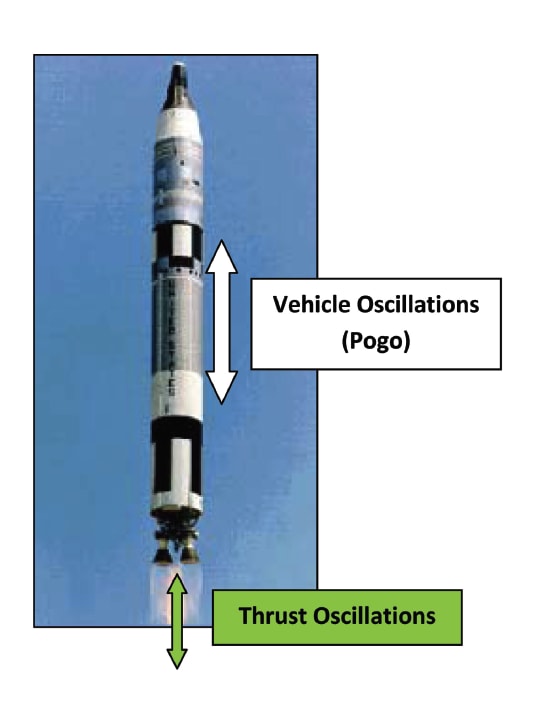
Beginning with the space shuttle development, NASA has mandated that Pogo cannot be present on any launch system. Extensive research and development efforts were put into the space shuttle engine design, which included pump dynamics testing at Caltech in the 1970s. The results were very successful, and the shuttle has flown for 30 years without any Pogo events. Now, as NASA is developing new launch assets, it is again necessary to ensure that the new vehicles and engines will also be Pogofree. The new test facility is an integral part of the efforts to continue NASA’s success with eliminating Pogo events from launch vehicles. It is the only facility of its kind in the United States, and one of only two in the world.
Determining Pogo
The transfer function is a four-element matrix that relates the changes in the dynamic mass flow and pressure across the pump to the dynamic mass flow and pressure at the pump inlet. Each of the terms is a complex number that includes both amplitude and phase. The transfer functions are determined by imposing at least two independent sets of smallamplitude mass flow and pressure perturbations at a given frequency on the mean inducer flow. The results of the perturbations are then measured upstream and downstream of the pump to determine the four complex numbers that make up the transfer function matrix.
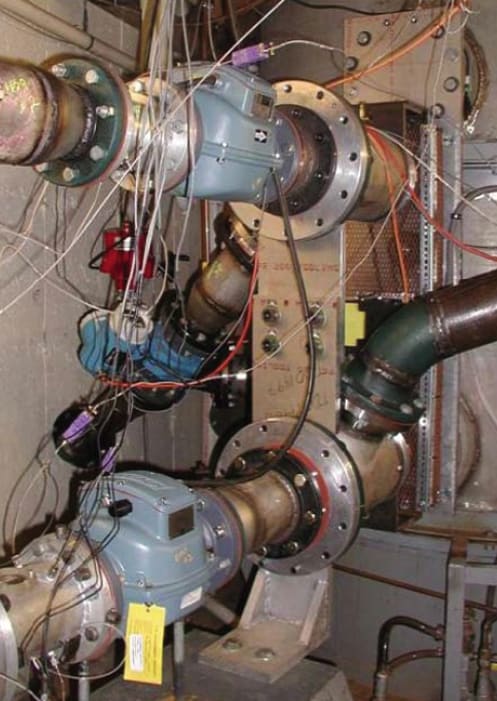
One particular concern is accurately measuring the small flow perturbations with the desired frequency response. Typical flow meters are low-frequency or averaging meters that cannot capture the frequencies of the pulsing flow in the loop. A bandwidth-enhanced EMF meter, developed for this application, allows accurate measurements of the pulsing flow. The meter is a regular EMF meter that is driven at a higher excitation frequency to cover the intended measurement bandwidth. In addition, special signal processing extracts the time-varying flow component from the signal to capture the flow rate changes with the pulsing.
A series of tests was conducted on the Space Shuttle Main Engine (SSME) low-pressure oxidizer turbopump (LPOTP) inducer to replicate what was done in the 1970s at Caltech, and confirm the results from this new test facility. The tests compared the hardware, test procedures, and data reduction techniques against the earlier successful results and show that CN has a validated dynamic transfer function test platform.
The test platform is now in operation and being used to ensure that the next generation of rocket launch systems is safe and reliable.
This article was written by Kerry Oliphant of Concepts NREC, White River Junction, VT. The work was completed under a NASA Marshall SBIR grant contract by Dr. Daniel O. Baun, Principal Investigator. For more information, Click Here .











