A proposed miniature turbomolecular pump would be a prototype of high-vacuum sources for a forthcoming generation of miniature, portable mass spectrometers and other scientific instruments. The miniature turbomolecular pump would be an attractive alternative to currently available high-vacuum sources (including most commercial off-the-shelf turbomolecular pumps), which are too bulky and power-hungry to be practical for use in portable instruments.
The smallest currently available high-vacuum pumps are miniature ion pumps that operate at pumping speeds of <1 liter/second. Prior to the conception of the miniature turbomolecular pump, there were plans to use two miniature ion pumps to provide high vacuum to a developmental portable miniature quadrupole mass spectrometer. The miniature turbomolecular pump would be installed in place of the two ion pumps; its overall size would be similar to that of the combination of two ion pumps but with higher pumping speed.
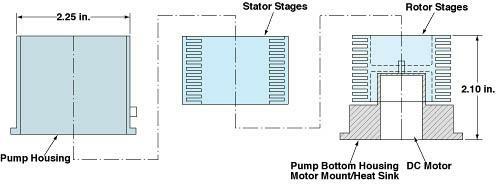
Like other turbomolecular pumps, the miniature turbomolecular pump would contain rows of rotor blades stacked in alternation with rows of stator blades, the spaces between the blades constituting passageways through which gas molecules would be pumped. The stator blades would be mirror images of the rotor blades. The rotor would be connected by a shaft to an off-the-shelf dc brushless motor, which would drive the rotor at a blade-tip speed as close as possible to the thermal speeds of the gas molecules to be pumped.
The pump design must be synthesized in an iterative procedure that involves consideration of blade angles, number of blades per row, hub diameter, and of gaps among rotor blades, stator blades, the hub, and the inner wall of the pump housing. The maximum pumping speed and compression ratio at smaller number of stages (pump size), predicted for a given combination of design parameters are evaluated with respect to the gas load or throughput. The resulting optimum parameters are then implemented towards the construction of the pump.
As in other vacuum systems, the miniature turbomolecular pump would be connected in series with a fore pump that would exhaust to the atmosphere. This will not be necessary for the case of EVA (extra-vehicular-activity) applications and hence a much smaller pump would result. The lowest pressure achievable inside a vacuum chamber depends on the compression ratios of the turbomolecular pump and fore pump.
The figure is a simplified representation of major components of the miniature turbomolecular pump according to the design under consideration at the time of reporting the information for this article. This design is optimized for operation in conjunction with a miniature diaphragm fore pump that provides an inlet pressure of about 1.5 torr (0.2 kPa). The rotor would spin at a speed of 157 krpm. The total compression ratio for air would be 105, and the pumping speed would be 6 liters/second. The peak power consumption is estimated at 8 W, decreasing to approximately 0.1 to 0.2 W at maximum rotor speed. Its weight excluding the backing pump is estimated to be about 11 oz (312 g).
This work was done by Vachik Garkanian of Caltech for NASA's Jet Propulsion Laboratory. NPO-20530
This Brief includes a Technical Support Package (TSP).
Miniature turbomolecular pump for high vacuum
(reference NPO20530) is currently available for download from the TSP library.
Don't have an account?
Overview
The document discusses the development of a Miniature Turbomolecular Pump (TMP) designed for high vacuum applications, particularly in portable scientific instruments such as mass spectrometers. This innovation, spearheaded by Vachik Garkanian at NASA's Jet Propulsion Laboratory, addresses the need for smaller, lighter, and more efficient vacuum systems that can operate effectively in various environments, including space missions.
The TMP operates by utilizing a DC brushless motor connected to a rotor, which spins at high speeds to create a vacuum by pumping gas molecules. The design process involves an iterative approach that considers various parameters, including blade angles, the number of blades, hub diameter, and the spacing between rotor and stator blades. The optimization of these parameters is crucial for achieving maximum pumping speed and compression ratios, which are essential for the pump's performance.
The document highlights the advantages of the miniature TMP over traditional larger pumps. It is significantly smaller and lighter, making it suitable for applications where weight and power consumption are critical. The use of off-the-shelf components, such as the DC brushless motor, contributes to lower power requirements and simplifies the design, which is beneficial for remote or space applications.
The TMP is designed to work in conjunction with a backing pump, which provides the necessary foreline pressure. The document specifies that the TMP can achieve a total compression ratio of 100,000 and a pumping speed of 3.0 liters per second, with a peak power consumption of approximately 8 watts. The weight of the pump, excluding the backing pump, is estimated to be around 11 ounces (312 grams).
In summary, the Miniature Turbomolecular Pump represents a significant advancement in vacuum technology, enabling high-performance vacuum systems that are compact and energy-efficient. This development is particularly relevant for scientific instruments that require high vacuum environments, enhancing their functionality and expanding their potential applications in various fields, including space exploration and portable analytical devices. The document serves as a technical support package detailing the design, advantages, and operational parameters of this innovative pumping system.