-1
30
30
Q&A: Sensors/Data Acquisition
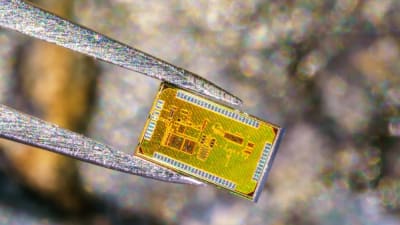
Professor Patrick Mercier and his team at the University of California, San Diego, have developed an RFID smart tag that uses the signals generated by a smartphone to both read and power it.
Q&A: Sensors/Data Acquisition
Zhiqun (Daniel) Deng and a team of researchers at the Pacific Northwest National Laboratory (PNNL) are working to develop a nanogenerator that harnesses the renewable energy of open ocean waves to power observation platforms, and more, in the middle of the ocean.

Q&A: Research Lab
Mateus Corato Zanarella is the lead author of a Nature Photonics article describing the creation of tunable visible lasers of very pure colors from near-ultraviolet to near-infrared that fit on a fingertip.

Q&A: Materials
Researchers have developed a theory that predicts the limits to which metals can be subjected to cyclic stress before failing.

Q&A: Materials
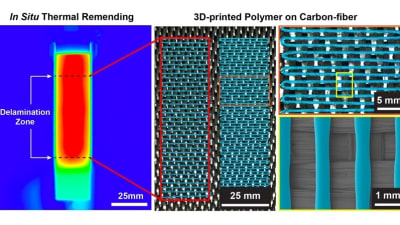
Jason Patrick, assistant professor of civil, construction, and environmental engineering at North Carolina State University, and his team have developed a new composite material for applications like airplane wings and wind turbine blades in which hidden defects and damage can self-heal.
Q&A: Medical
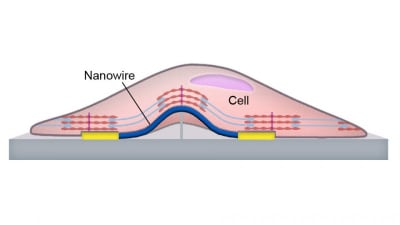
Professor Jun Yao and his team at the University of Massachusetts Amherst, have created a tiny sensor that can simultaneously measure electrical and mechanical cellular responses in cardiac tissue.
Q&A: Green Design & Manufacturing
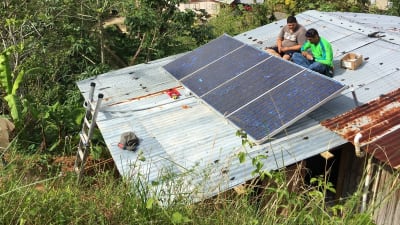
Ben Ollis and a team of engineers from Oak Ridge National Laboratory are creating a novel orchestrator tool to manage a cluster of microgrids so they can directly support and communicate with each other, making them more resilient during long power outages. It is being installed as a demonstration project in the small town of Adjuntas in the Central Mountains of Puerto Rico.
Q&A: Energy
Dr. Brandon Ennis, Sandia National Laboratories’ offshore wind technical lead, had a radically new idea for offshore wind turbines: instead of a tall unwieldy tower, with blades at the top, he imagined a towerless turbine with blades pulled taut like a bow.

Q&A: Energy
A new kind of optical concentrator can passively focus the sun onto a photovoltaic cell from any angle to reduce the amount of photovoltaic material needed for a given amount of power generation.
Q&A: Robotics, Automation & Control
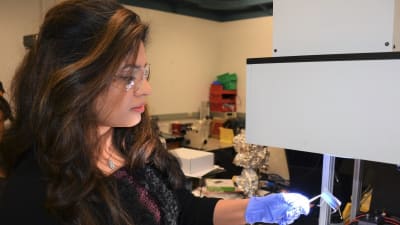
A team of engineers from the University of Glasgow led by Professor Ravinder Dahiya developed an artificial skin with a new type of processing system based on...

Q&A: Manufacturing & Prototyping
Professor Robert MacCurdy and his team at the University of Colorado at Boulder have developed and characterized a method to print 3D structures with the simultaneous use of different...

Q&A: RF & Microwave Electronics
Professor Kenneth K. O. and his colleagues at The University of Texas at Dallas and Oklahoma State University have developed an innovative and affordable terahertz imager microchip that can enable...

Q&A: Energy
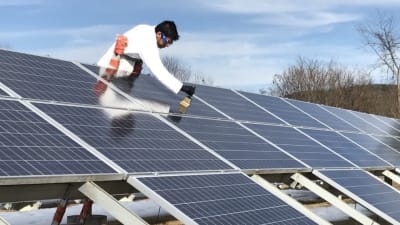
An inexpensive, clear coating has reduced snow and ice accumulation on solar panels, enabling them to generate up to 85% more energy in early testing.
Q&A: Electronics & Computers
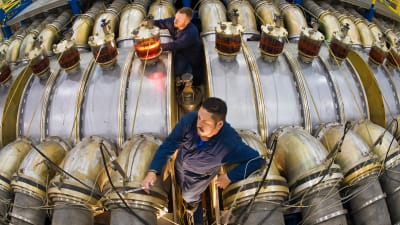
Dr. Israel Owens and his team at Sandia National Laboratories have used a crystal smaller than a dime and a laser smaller than a shoebox to safely measure 20 million volts without making physical contact to the electrode.
Q&A: Materials
Professor Jiwoong Park and his team have made a material that is crystalline in the X-Y direction, but amorphous in the Z direction.

Q&A: Manufacturing & Prototyping
An "E-Skin" material can be printed without polymer binders.

Q&A: AR/AI
New lithium-ion batteries that can be charged in 10 to 15 minutes at a roadside charging station.

Q&A: Automotive
Jingcheng Ma, along with a team of researchers at the University of Illinois, Urbana-Champaign, found a way to make ultra-thin water-resistant surface coatings robust enough to survive...

Q&A: Green Design & Manufacturing
A chemical process produces valuable biodegradable chemicals from discarded plastics.
Q&A: Materials
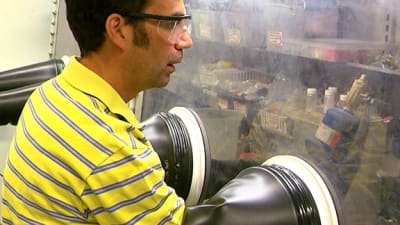
Fiorenzo Omenetto, Frank C. Doble Professor of Engineering at Tufts University School of Engineering, Dean of Research, and Director of the Tufts Silklab led a team that has produced...

Q&A: Electronics & Computers
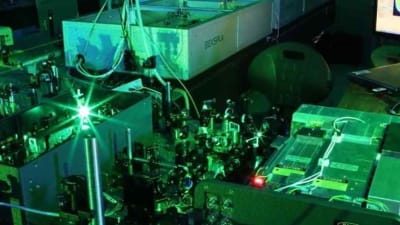
Kristin Sampayan from the Lawrence Livermore National Laboratory found a fast way to switch high voltages.
Q&A: Energy
Dr. Burak Ozpineci is developing a system that charges electric vehicles while driving.

Q&A: Sensors/Data Acquisition
New autonomous robotic devices can survey hazardous or difficult-to-reach sites faster than humans.

Q&A: Sensors/Data Acquisition
Rutgers researcher Xiaoran Fan developed a "HeadFi" method that uses ordinary headphones as sensors.

Q&A: Energy
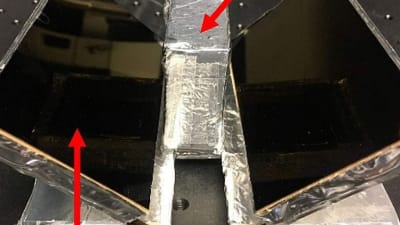
Professor Qiaoqiang Gan of the University at Buffalo (NY) and his team developed a unique two-in-one system that uses solar energy for simultaneously cooling and heating — without electricity.
Q&A: Electronics & Computers
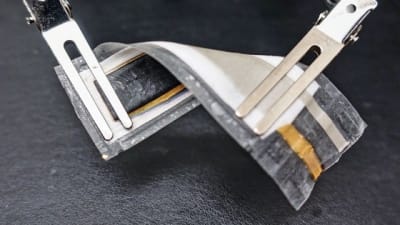
Professor Shirley Meng explains why there's a demand for stretchable batteries.
Q&A: Energy
USC researchers found a way to use idle oil and gas wells for energy storage.

Q&A: Materials
Brian Salazar and his UC Berkeley team have developed a new way to reinforce concrete with a polymer lattice, an advance that could rival other polymer-based enhancements and improve...

Q&A: Sensors/Data Acquisition
See how Dr. Andrei Kolmakov and his team are using low-energy electron beams to 3D-print tiny gel structures in liquids.

Top Stories
 Blog: Lighting

A Stretchable OLED that Can Maintain Most of Its Luminescence
 Blog: Energy

Batteries that Can Withstand the Cold
 INSIDER: Energy

Advancing All-Solid-State Batteries
 Quiz: Energy

 Blog: Physical Sciences

 Blog: Materials

Webcasts
 Upcoming Webinars: Test & Measurement

From Spreadsheets to Insights: Fast Data Analysis Without Complex...
 Upcoming Webinars: Electronics & Computers

Cooling a New Generation of Aerospace and Defense Embedded...
 Upcoming Webinars: Test & Measurement

Beyond AI-Copy-Paste Engineering: Advanced AI-Integration Success...
 Upcoming Webinars: Automotive

Battery Abuse Testing: Pushing to Failure
 Upcoming Webinars: Internet of Things

A FREE Two-Day Event Dedicated to Connected Mobility
 Upcoming Webinars: Test & Measurement

Choosing the Right N-Port Strategy: Multiport VNAs vs. Switch...