Ultrasonic/sonic rotary-hammer drill (USRoHD) is a recent addition to the collection of apparatuses based on ultrasonic/sonic drill corer (USDC). As described below, the USRoHD has several features, not present in a basic USDC, that increase efficiency and provide some redundancy against partial failure.
USDCs and related apparatuses were conceived for boring into, and/or acquiring samples of, rock or other hard, brittle materials of geological interest. They have been described in numerous previous NASA Tech Briefs articles.
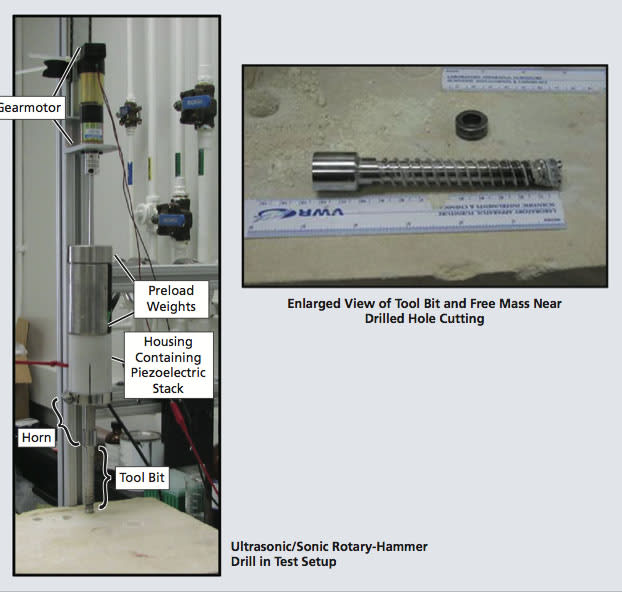
In early USDC experiments, it was observed that accumulation of cuttings in a drilled hole causes the rate of penetration of the USDC to decrease steeply with depth, and that the rate of penetration can be increased by removing the cuttings. The USRoHD concept provides for removal of cuttings in the same manner as that of a twist drill: An USRoHD includes a USDC and a motor with gearhead (see figure). The USDC provides the bit hammering and the motor provides the bit rotation. Like a twist drill bit, the shank of the tool bit of the USRoHD is fluted. As in the operation of a twist drill, the rotation of the fluted drill bit removes cuttings from the drilled hole.
The USRoHD tool bit is tipped with a replaceable crown having cutting teeth on its front surface. The teeth are shaped to promote fracturing of the rock face through a combination of hammering and rotation of the tool bit. Helical channels on the outer cylindrical surface of the crown serve as a continuation of the fluted surface of the shank, helping to remove cuttings.
In the event of a failure of the USDC, the USRoHD can continue to operate with reduced efficiency as a twist drill. Similarly, in the event of a failure of the gearmotor, the USRoHD can continue
to operate with reduced efficiency as a USDC.
This work was done by Mircea Badescu, Stewart Sherrit, Yoseph Bar-Cohen, Xiaoqi Bao, and Steve Kassab of Caltech for NASA’s Jet Propulsion Laboratory. For more information, download the Technical Support Package (free white paper) at www.techbriefs.com/tsp under the Mechanics/Machinery category.
This invention is owned by NASA, and a patent application has been filed. Inquiries concerning nonexclusive or exclusive license for its commercial development should be addressed to
the Patent Counsel
NASA Management Office–JPL.
Refer to NPO-44765.
This Brief includes a Technical Support Package (TSP).
Ultrasonic/Sonic Rotary-Hammer Drills
(reference NPO-44765) is currently available for download from the TSP library.
Don't have an account?
Overview
The document presents an overview of the Ultrasonic/Sonic Rotary-Hammer Drill (USRoHD), a novel drilling technology developed for NASA's exploration missions. This innovative drill combines ultrasonic/sonic actuation with motor-driven rotation to enhance drilling efficiency, speed, and depth of penetration into various planetary materials. The design features a unique hammering mechanism that impacts the drill bit while simultaneously allowing for rotation, which is crucial for effective removal of powdered cuttings generated during the drilling process.
Key highlights of the USRoHD include its decoupled hammering and rotation mechanisms, which provide operational redundancy. This means that if one mechanism fails, the other can still function, ensuring continued drilling capability. The drill bit is specifically designed with flutes that facilitate the upward movement of cuttings, preventing accumulation that could slow down the drilling process. The document emphasizes the importance of this technology for subsurface access, which is vital for astrobiological studies and the search for life on other planets, particularly Mars and Europa.
The report outlines the challenges faced in drilling operations, such as the accumulation of cuttings and the limitations of using pressurized gas for cuttings removal, especially in low-pressure environments like Mars. The USRoHD addresses these challenges by utilizing a combination of slow-speed rotation and hammering action, which effectively produces fine powdered cuttings while maintaining structural integrity.
Additionally, the document discusses the broader implications of this technology for future NASA missions, highlighting its potential applications in in-situ analysis and scientific experiments aimed at detecting life and water, as well as characterizing materials on other planets. The development of subsurface-access technology is identified as a high priority in the Decadal Study report by the National Academy of Sciences, underscoring the significance of the USRoHD in advancing planetary exploration strategies.
In summary, the USRoHD represents a significant advancement in drilling technology, offering a reliable and efficient means of accessing subsurface materials on planetary bodies. Its innovative design and operational features position it as a critical tool for future exploration missions, contributing to our understanding of extraterrestrial environments and the potential for life beyond Earth.