Inside this issue
Supplements
Overview
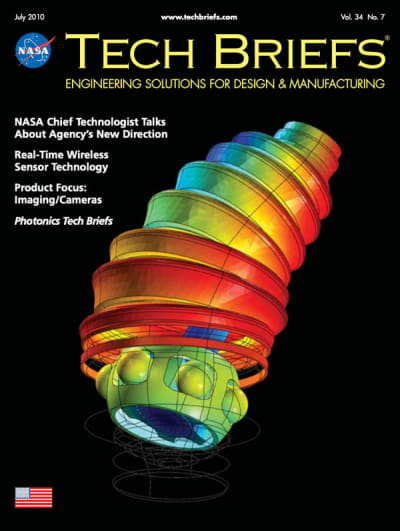
The July 2010 issue of NASA Tech Briefs, along with its supplements Photonics Tech Briefs and Embedded Technology, presents a comprehensive overview of the latest advancements and innovations in technology, particularly in the fields of aerospace, photonics, and embedded systems. This edition is notable for its focus on real-time wireless sensor technology, new product developments, and insights from key figures in the industry.
Key Highlights:
-
NASA's New Direction: The issue features an interview with NASA's Chief Technologist, who discusses the agency's evolving focus and strategic initiatives. This includes a commitment to innovation and collaboration with private industry to enhance technological capabilities and address future challenges in space exploration.
-
Real-Time Wireless Sensor Technology: A significant portion of the magazine is dedicated to advancements in wireless sensor technology. This technology is crucial for various applications, including monitoring environmental conditions, structural health, and operational efficiency in aerospace systems. The article outlines how real-time data collection and analysis can lead to improved decision-making and operational safety.
-
Product Focus: Imaging and Cameras: The magazine highlights the latest developments in imaging and camera technologies. This includes discussions on the integration of advanced optics and sensors that enhance image quality and functionality. The introduction of thin-film filters, which allow for wavelength selection without the need for physical filter changes, is a notable innovation discussed in the issue.
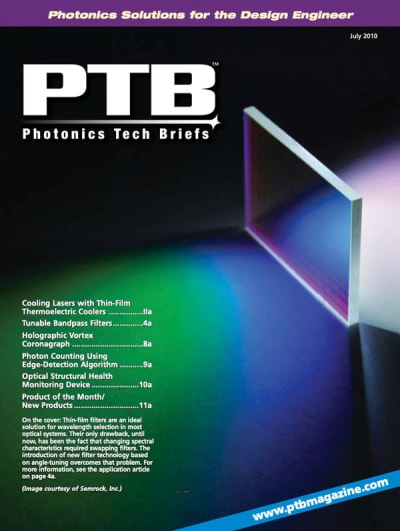
Photonics Innovations: The Photonics Tech Briefs supplement features articles on cutting-edge photonics solutions. Topics include:
- Cooling Lasers with Thin-Film Thermoelectric Coolers: This article explores new methods for managing heat in laser systems, which is critical for maintaining performance and longevity.
- Tunable Bandpass Filters: The introduction of angle-tuning technology for filters is discussed, highlighting its advantages in optical systems.
- Holographic Vortex Coronagraph: This innovative device is designed for astronomical observations, allowing for the study of celestial bodies by reducing the glare from stars.
-
Optical Structural Health Monitoring: An article discusses the development of optical devices for monitoring the structural health of various systems. This technology is essential for ensuring the integrity and safety of aerospace structures, as it allows for real-time assessment and early detection of potential issues.
-
New Products and Technologies: The issue includes a section dedicated to new products, showcasing the latest technologies available in the market. This includes advancements in solid-state drives, network processors, and military satellite communications. Each product is accompanied by a brief description of its features and potential applications.
-
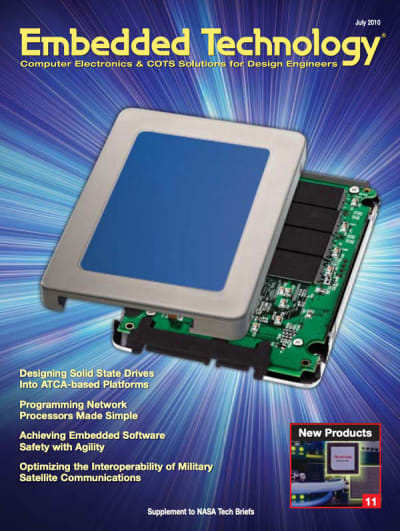
Embedded Technology Insights: The Embedded Technology supplement focuses on the integration of embedded systems in various applications. Key topics include:
- Designing Solid State Drives into ATCA-based Platforms: This article discusses the challenges and solutions for integrating solid-state drives into Advanced Telecommunications Computing Architecture (ATCA) systems.
- Programming Network Processors: Simplifying the programming of network processors is crucial for enhancing performance and efficiency in data handling.
- Achieving Embedded Software Safety with Agility: This article emphasizes the importance of safety in embedded software development, particularly in critical applications.
-
Lighting Technology: A new digital magazine dedicated to lighting technology is introduced, featuring design tutorials, technical reports, application notes, and new products aimed at energy-efficient lighting design. This addition reflects the growing importance of sustainable practices in technology development.
Conclusion:
The July 2010 issue of NASA Tech Briefs, along with its supplements, serves as a valuable resource for engineers, researchers, and industry professionals. It provides insights into the latest technological advancements, practical applications, and future directions in aerospace, photonics, and embedded systems. The emphasis on innovation, safety, and collaboration highlights the ongoing efforts to push the boundaries of technology and improve operational efficiencies across various sectors. This issue not only informs readers about current trends but also inspires future developments in these critical fields.
Features
-
Application Briefs
Cockpit Vision System to Improve Pilot Safety
Vibration Isolators Supplied for James Webb Telescope Testing
Tech Briefs
-
Physical Sciences
Wirelessly Interrogated Wear or Temperature Sensors
Radio-Frequency Tank Eigenmode Sensor for Propellant Quantity Gauging
High-Temperature Optical Sensor
Fuel-Cell Power Source Based on Onboard Rocket Propellants
Polar Lunar Regions: Exploiting Natural and Augmented Thermal Environments
Improved Speed and Functionality of a 580-GHz Imaging Radar
Bolometric Device Based on Fluxoid Quantization
Simultaneous Spectral Temporal Adaptive Raman Spectrometer — SSTARS
-
Manufacturing & Prototyping
Processing Nanostructured Sensors Using Microfabrication Techniques
-
Software
Automated Computer Access Request System
Range Safety for an Autonomous Flight Safety System
-
Materials
Exfoliated Graphite Nano-Reinforcements With Surface Modifications to Improve Dispersability
MicroGel® for Passivation of Pigment Degradation
Producing Synthetic Agglutinates in Simulated Lunar Regolith
-
Information Sciences
Algorithms for Learning Preferences for Sets of Objects
Algorithms for High-Speed Noninvasive Eye-Tracking System
Model for Simulating a Spiral Software-Development Process
-
Mechanics & Machinery
Ultrasonic/Sonic Rotary-Hammer Drills
Miniature Piezoelectric Shaker for Distribution of Unconsolidated Samples to Instrument Cells
-
Electronics & Computers
Integral Battery Power Limiting Circuit for Intrinsically Safe Applications
Products
-
Applications