

An improved alignment mechanism and mating procedure have been devised for a robotic drilling system in which there is a need to assemble drill stem rods for sampling soils and rocks on a distant planet or asteroid. This mechanism is applicable to systems requiring positive axial alignment between segments. Similar mechanisms could be used on Earth, not only for assembling long drills but also for any system where a series of rods must be robotically assembled, such as in truss construction.

Conventional robotically actuated drill-stem segmenting systems use alignment keys that often feature polygonal protrusions. Figure 1 shows a conceptual example. These mechanisms, while ensuring correct rotational alignment, are susceptible to jamming in a misaligned position. To prevent such jamming, complex control systems must be implemented that can provide fairly accurate alignment between the stem segments prior to any mechanical engagement. Additional control must also be implemented to deal with the possibility that jamming occurs.

The improved alignment mechanism and mating procedure preclude any chance of jamming during assembly. The mechanism also does not require rotational alignment prior to engagement. The interface is a “half dog clutch,” a mating scheme where two half cylinders are mated together (see Figure 2). However, the alignment keys are cut so as to produce a helical face. These keys are used for rotational alignment as well as torque transfer between segments. In the current implementation, an additional pilot is used to ensure axial alignment, but this feature may not always be necessary. The following steps are used to mate the segments:
- The segments to be aligned are moved toward each other until contact between them is sensed. It may be beneficial to slowly rotate one of the rods in the direction opposite that of a flat cut that is part of the alignment key to help ensure that the helical faces of the dogs contact first.
- The rods are moved apart to a distance that is fraction of the height of the alignment key.
- The rods are re-engaged by simultaneous rotation and translation in such a way that the tip of the alignment key travels parallel to the helical alignment-key surface. This motion ensures that next contact will be between driving faces, at which time positive axial alignment is achieved.
- The axial-rotational movement can continue until full engagement of the segments is achieved and detected, assuming that one segment is held freely so that the other may drive it.
Note that for this entire process only two simple sensory inputs are required. At no point must the control system know the rotational position of either segment.
This work was done by Benjamin Dolgin and Stephen Askins of Caltech for NASA’s Jet Propulsion Laboratory. For further information, access the Technical Support Package (TSP) free on-line at www.nasatech.com/tsp under the Mechanics category. NPO-21164
This Brief includes a Technical Support Package (TSP).
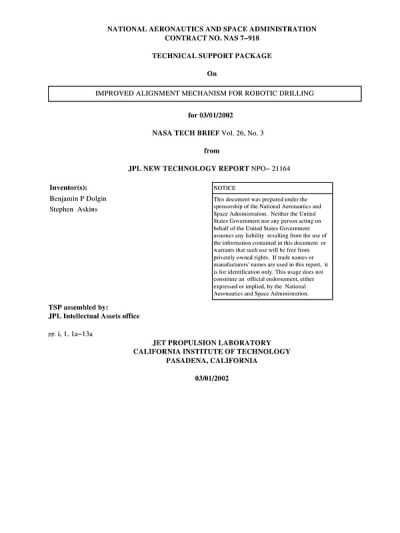
Improved Alignment Mechanism for Robotic Drilling
(reference NPO-21164) is currently available for download from the TSP library.
Don't have an account?
Overview
The document is a technical support package from NASA, specifically detailing an improved alignment mechanism for robotic drilling, developed by inventors Benjamin P. Dolgin and Stephen Askins. This innovation is particularly relevant for sampling soils and rocks on celestial bodies like comets and asteroids, addressing a critical challenge in robotic drilling operations.
The primary motivation behind this invention is the difficulty in assembling drill stem rods due to potential misalignment. When drill stems are misaligned, the alignment key can become jammed, preventing the necessary rotation to correct the alignment. This situation complicates the operation, requiring a complex system of sensors and controls to detect misalignment, disconnect the stems, and attempt realignment.
The proposed solution is a novel rotational alignment key, which features a helical cut at the end of the rod. This design allows for both rough and final alignment, as well as torque transfer. The alignment procedure involves several steps: first, the elements to be aligned are brought together until contact is detected. A limit switch signals this event. Next, the elements are disengaged slightly to create a gap that corresponds to the height of the alignment key. The elements are then re-engaged through simultaneous rotation and translation, ensuring that the tip of the alignment key moves parallel to the helical surface. This motion guarantees a positive lock of the alignment keys, followed by axial translation to fully engage the alignment key.
The document also highlights the accomplishments of the robotic drilling project, including successful sampling at depths greater than a single drill stem and the development of a novel stem assembly approach that accommodates misaligned stems. The project has demonstrated the capability of full drill stem assembly and disassembly under controlled conditions, achieving sampling depths of up to 50 cm.
Overall, this technical support package outlines a significant advancement in robotic drilling technology, enhancing the reliability and efficiency of operations in extraterrestrial environments. The innovative alignment mechanism not only simplifies the assembly process but also reduces the risk of operational failures, paving the way for more effective exploration of other planets and celestial bodies.










