

A series of free-mass designs for the ultrasonic/sonic driller/corer (USDC) has been developed to maximize the transfer of energy from the piezoelectric transducer through the horn to the bit, as well as to minimize potential jamming. A systematic development was made producing novel designs of freemass configurations where the impact force is spread across a minimal area maximizing the impact on the bit. The designed free masses were made to operate at high temperatures (500 °C) as on Venus, and they can be made to operate at extremely low temperature, too.
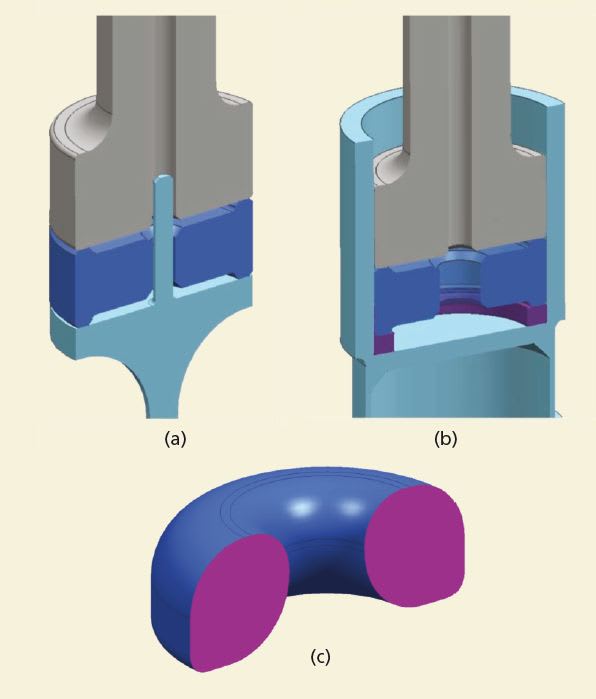
For this purpose, seven different designs were conceived: point contacts, circular contacts, point/circular contacts, line contacts, ring contacts, line/ring contacts, and dashed line contacts. Besides point/ circular and line/ring contacts, the free mass can be designed as any of the above shapes. Depending on the ratio of the diameter to the height, and the free-mass retention method used (the cup or rod), the free mass can be configured with one or more sliding surfaces on the outside or inside diameter surface or both. Matching horn tips and free mass may also offer some utility in maximizing the stress pulse.
This work was done by Xiaoqi Bao, Stewart Sherrit, Mircea Badescu, Yoseph Bar-Cohen, Steve Atkins, and Patrick N. Ostlund of Caltech for NASA’s Jet Propulsion Laboratory.
In accordance with Public Law 96-517, the contractor has elected to retain title to this invention. Inquiries concerning rights for its commercial use should be addressed to:
Innovative Technology Assets Management
JPL
Mail Stop 202-233
4800 Oak Grove Drive
Pasadena, CA 91109-8099
E-mail: This email address is being protected from spambots. You need JavaScript enabled to view it.
NPO-47780
This Brief includes a Technical Support Package (TSP).
Free-Mass and Interface Configurations of Hammering Mechanisms
(reference NPO-47780) is currently available for download from the TSP library.
Don't have an account?
Overview
The document titled "Free-Mass and Interface Configurations of Hammering Mechanisms" is a technical support package from NASA's Jet Propulsion Laboratory (JPL) that discusses advancements in drilling technology, particularly for in-situ exploration missions. The focus is on the ultrasonic/sonic driller/corer (USDC), a mechanism designed to enhance the effectiveness of drilling operations in space environments.
The USDC operates by converting high-frequency ultrasonic vibrations generated by piezoelectric actuators into lower-frequency sonic vibrations suitable for drilling. A critical component of this mechanism is the free-mass, which plays a vital role in energy transfer from the transducer through the horn to the drill bit. The document outlines the challenges faced with previous free-mass designs, particularly issues related to jamming and operational reliability.
The original design featured a steel disk with a rod insert, which was later modified to eliminate the rod in favor of a solid cylinder shape free-mass retained within a hollow cylinder or "cup." This redesign significantly improved the durability and performance of the drill bit. The document includes illustrations comparing the original rod configuration and the improved cup configuration.
Additionally, the document discusses the importance of contact area between the free-mass, horn, and bit. A larger contact area can reduce stress and improve coupling, but it can also complicate the vibration characteristics, making the USDC difficult to start. To address these conflicting requirements, a catalog of free-mass designs was conceived, including point contacts and various shapes to optimize performance.
The research aims to refine the design of the free-mass to maximize energy transfer while minimizing potential jamming, thereby enhancing the operational reliability of drilling mechanisms for future NASA missions. The document emphasizes the critical need for effective drilling technologies in the exploration of extraterrestrial environments, where sample collection and analysis are essential for detecting potential biomarkers and understanding geological properties.
Overall, this technical support package highlights the innovative approaches taken by the JPL team to advance drilling technology, which could have broader applications beyond space exploration, contributing to various technological, scientific, and commercial fields.











