Sampling cores requires the controlled breakoff of the core at a known location with respect to the drill end. An additional problem is designing a mechanism that can be implemented at a small scale that is robust and versatile enough to be used for a variety of core samples. This design consists of a set of tubes (a drill tube and an inner tube) and a rolling element (rolling tooth). An additional tube can be used as a sample tube. The drill tube and the inner tube have longitudinal holes with the axes offset from the axis of each tube. The two eccentricities are equal. The inner tube fits inside the drill tube, and the sample tube fits inside the inner tube. 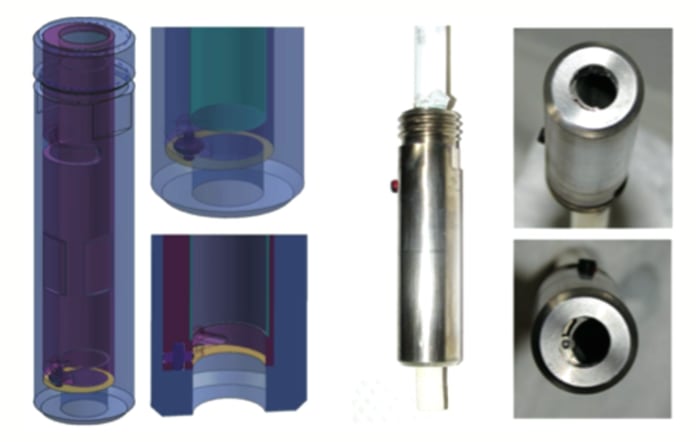
This invention is potentially applicable to sample return and in situ missions to planets such as Mars and Venus, to moons such as Titan and Europa, and to comets. It is also applicable to terrestrial applications like forensic sampling and geological sampling in the field.
This work was done by Mircea Badescu, Donald B. Bickler, Stewart Sherrit, Yoseph Bar-Cohen, Xiaoqi Bao, and Nicolas H. Hudson of Caltech for NASA’s Jet Propulsion Laboratory. NPO-47354
This Brief includes a Technical Support Package (TSP).
Rolling-Tooth Core Breakoff and Retention Mechanism
(reference NPO-47354) is currently available for download from the TSP library.
Don't have an account?
Overview
The document presents a technical disclosure of NASA's Rolling-Tooth Core Break-Off and Retention Mechanism, identified as NPO-47354. This innovative mechanism addresses the challenge of sampling cores by enabling the controlled break-off of core samples at predetermined locations relative to the drill bit. The design is particularly relevant for space exploration missions, including potential sample return missions to Mars and other celestial bodies.
The core break-off mechanism consists of a set of eccentric tubes—a drill tube, an inner tube, and an optional sample tube—along with a rolling element known as a rolling tooth. The inner tube fits inside the drill tube, and both tubes have longitudinal holes that are offset from their axes, allowing for precise control during the drilling process. The rolling element is passively controlled by rotating the outer tube in the opposite direction of the normal drilling rotation, which engages the core and facilitates its break-off.
Key features of the mechanism include its ability to act as both a core breaking and retention device, utilizing the same actuator for both functions. The rolling tooth can score the core, lock it to the inner tube, and assist in breaking it off through torsion or shear forces. This dual functionality is a significant advancement over previous technologies, as it combines core sampling and retention in a compact and efficient design.
The disclosed mechanism is particularly applicable to NASA's exploration missions, supporting the goals of in-situ analysis and sample caching for future return to Earth. It is designed to fit within the dimensions of existing coring bits, making it suitable for various planetary missions, including those targeting Mars, Venus, and moons like Titan and Europa. Additionally, the technology has potential terrestrial applications in fields such as forensic sampling and geological exploration.
Overall, this document highlights a critical advancement in core sampling technology, addressing both the technical challenges of space exploration and the need for efficient sample acquisition methods. The mechanism's innovative design and functionality position it as a valuable asset for future NASA missions and other scientific endeavors.