A methodology is emerging from efforts to design a mission operations facility.
A methodology for designing operational facilities for collaboration by multiple experts has begun to take shape as an outgrowth of a project to design such facilities for scientific operations of the planned 2003 Mars Exploration Rover (MER) mission. The methodology could also be applicable to the design of military "situation rooms" and other facilities for terrestrial missions.
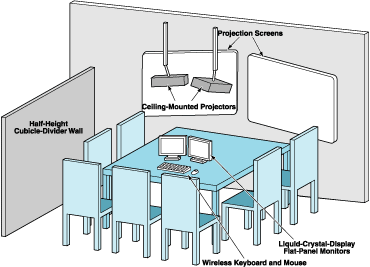
One element of the methodology is a metric, called effective capacity, that was created for use in evaluating proposed MER operational facilities and may also be useful for evaluating other collaboration spaces, including meeting rooms and military situation rooms. The effective capacity of a facility is defined as the number of people in the facility who can be meaningfully engaged in its operations. A person is considered to be meaningfully engaged if the person can (1) see, hear, and communicate with everyone else present; (2) see the material under discussion (typically data on a piece of paper, computer monitor, or projection screen); and (3) provide input to the product under development by the group. The effective capacity of a facility is less than the number of people that can physically fit in the facility. For example, a typical office that contains a desktop computer has an effective capacity of ≈4, while a small conference room that contains a projection screen has an effective capacity of around 10. Little or no benefit would be derived from allowing the number of persons in an operational facility to exceed its effective capacity: At best, the operations staff would be underutilized; at worst, operational performance would deteriorate.
Elements of this methodology were applied to the design of three operations facilities for a series of rover field tests. These tests were observed by human-factors researchers and their conclusions are being used to refine and extend the methodology to be used in the final design of the MER operations facility.
Further work is underway to evaluate the use of personal digital assistant (PDA) units as portable input interfaces and communication devices in future mission operations facilities. A PDA equipped for wireless communication and Ethernet, Bluetooth, or another networking technology would cost less than a complete computer system, and would enable a collaborator to communicate electronically with computers and with other collaborators while moving freely within the virtual environment created by a shared immersive graphical display.
This work was done by Jeffrey Norris, Mark Powell, Paul Backes, Robert Steinke, and Kam Tso of Caltech and Roxana Wales of Ames Research Center for NASA's Jet Propulsion Laboratory. For further information, access the Technical Support Package (TSP) free on-line at www.techbriefs.com/tsp under the Information Sciences category. NPO-30457.
This Brief includes a Technical Support Package (TSP).
Designing Facilities for Collaborative Operations
(reference NPO-30457) is currently available for download from the TSP library.
Don't have an account?
Overview
The document outlines a methodology developed by NASA's Jet Propulsion Laboratory (JPL) for designing collaborative operations facilities, particularly in the context of the Mars Exploration Rover (MER) mission. It emphasizes the critical role that facility layout plays in enhancing the efficiency and endurance of operations staff. Over two years of operations tests revealed that the design of the workspace significantly impacts team performance, prompting the development of novel facility layouts.
A key component of this methodology is the introduction of a metric called "effective capacity." This metric defines the number of individuals who can be meaningfully engaged in a facility's operations, considering factors such as visibility, audibility, and the ability to contribute to discussions. For instance, a typical office with a desktop computer has an effective capacity of approximately four, while a small conference room with a projection screen can accommodate around ten. The document stresses that exceeding this effective capacity can lead to underutilization of staff and deteriorating operational performance.
The methodology was applied to the design of three operations facilities for rover field tests, with human-factors researchers observing the tests and providing feedback. This feedback was instrumental in refining the design principles and evaluation metrics used in the final design of the MER operations facility. The document also discusses the potential application of these principles to other collaborative spaces, such as military situation rooms and meeting areas.
Additionally, the document introduces a modular approach to operations facility design, allowing for flexibility and adaptability in various contexts. It also presents a novel concept for using Personal Digital Assistants (PDAs) as input devices in operations, marking a significant advancement in the integration of technology in mission operations.
Overall, the document represents a fundamental shift in how mission operations facilities are designed, moving away from ad-hoc layouts to more structured, research-informed designs that prioritize effective collaboration. This innovative approach aims to enhance the effectiveness and efficiency of future mission operations, ultimately contributing to the success of complex scientific endeavors like the Mars Exploration Rover mission.