

This software graphically displays all pertinent information from a Predicted Events File (PEF) using the Java Swing framework, which allows for multi-platform support. The PEF is hard to weed through when looking for specific information and it is a desire for the MRO (Mars Reconn aissance Orbiter) Mission Planning & Sequencing Team (MPST) to have a different way to visualize the data. This tool will provide the team with a visual way of reviewing and error-checking the sequence product.
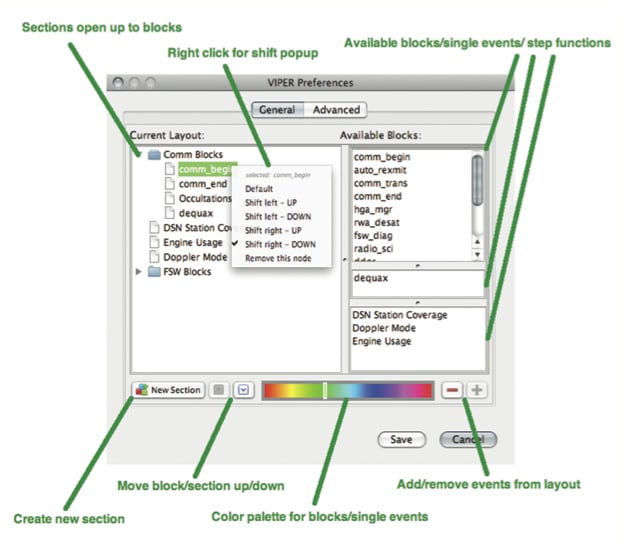
Double-clicking on a block will show information contained within the block. Zooming into a certain level will graphically display that information as an overlay on the block itself. Other functions include using hotkeys to navigate, an option to jump to a specific time, enabling a vertical line, and double-clicking to zoom in/out.
The back end involves a configuration file that allows a more experienced user to pre-define the structure of a block, a single event, or a step function. The individual will have to determine what information is important within each block and what actually defines the beginning and end of a block. This gives the user much more flexibility in terms of what the tool is searching for. In addition to the configurability, all the settings in the preferences window are saved in the configuration file as well.
This work was done by Victor Luo, Teerapat Khanampornpan, Rudy A. Boehmer, and Rachel Y. Kim of Caltech for NASA’s Jet Propulsion Laboratory.
This software is available for commercial licensing. Please contact Daniel Broderick of the California Institute of Technology at
This Brief includes a Technical Support Package (TSP).
Visual PEF Reader — VIPER
(reference NPO-47509) is currently available for download from the TSP library.
Don't have an account?
Overview
The document is a Technical Support Package for the Visual PEF Reader (VIPER), developed by NASA's Jet Propulsion Laboratory (JPL) under a contract with the National Aeronautics and Space Administration (NASA). VIPER is designed to enhance the visualization and analysis of spacecraft event data, providing a user-friendly interface for mission operations.
Key features of VIPER include the ability to display various types of blocks (such as comm_begin and hga_mgr) and step-functions (like engine usage and Doppler mode). The tool allows users to view critical time metrics, including Spacecraft Event Time (SCET), Earth Time (ETT), and Event Real Time (ERT) at the cursor's position. Users can zoom in and out of the timeline, jump to specific times in the sequence, and drill down into each block for more detailed information. Additionally, VIPER supports One-Way-Light-Time (OWLT) adjustments, enabling users to shift sections of the timeline accordingly.
The document outlines the configuration options available for VIPER, including the path for light time files, font sizes (Tiny, Medium, or Large), and various block definitions. It emphasizes the importance of user interaction, allowing for intuitive navigation through the data, such as dragging the mouse to initialize a time ruler and auto-snapping to the edges of events.
The Technical Support Package also includes contact information for further assistance, highlighting the role of the Innovative Technology Assets Management team at JPL. It notes that the information provided is subject to U.S. export regulations and may contain proprietary information.
Overall, the document serves as a comprehensive guide to the capabilities and functionalities of the Visual PEF Reader, emphasizing its role in improving the efficiency and effectiveness of spacecraft mission operations. By providing a clear and organized way to visualize complex data, VIPER aims to facilitate better decision-making and enhance the overall mission experience for users.











