

A mechanical amplifier has been devised to multiply the stroke of a piezoelectric transducer (PZT) intended for use at liquid helium temperatures. Interferometry holds the key to high angular resolution imaging and astrometry in space. Future space missions that will detect planets around other solar systems and perform detailed studies of the evolution of stars and galaxies will use new interferometers that observe at mid- and far-infrared wavelengths. Phase-measurement interferometry is key to many aspects of astronomical interferometry, and PZTs are ideal modulators for most methods of phase measurement, but primarily at visible wavelengths. At far infrared wavelengths of 150 to 300 µm, background noise is a severe problem and all optics must be cooled to about 4 K. Under these conditions, piezos are ill-suited as modulators, because their throw is reduced by as much as a factor of 2, and even a wavelength or two of modulation is beyond their capability. The largest commercially available piezo stacks are about 5 in. (12.7 cm) long and have a throw of about 180 µm at room temperature and only 90 μm at 4 K. It would seem difficult or impossible to use PZTs for phase measurements in the far infrared were it not for the new mechanical amplifier that was designed and built.
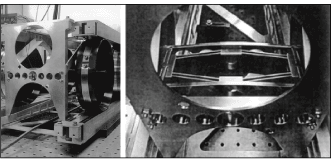
This new mechanical amplifier provides both a longer stroke for standard piezo stacks and the necessary mechanical stability through an ingenious mounting arrangement. The device is made of titanium and machined using a wire EDM (electrical-discharge machining) process so as to be as strong and lightweight as possible. It is compact using only a single piezo stack, making it ideally suited for phase-measurement in a cryogenic environment.
This work was done by James Moore, Mark Swain, Peter Lawson, and Robert Calvet of Caltech for NASA's Jet Propulsion Laboratory. For further information, access the Technical Support Package (TSP) free on-line at www.techbriefs.com/tsp under the Mechanics category. NPO-30289.
This Brief includes a Technical Support Package (TSP).
Mechanical Amplifier for a Piezoelectric Transducer
(reference NPO-30289) is currently available for download from the TSP library.
Don't have an account?
Overview
The document is a technical support package from NASA's Jet Propulsion Laboratory (JPL) detailing a novel mechanical amplifier designed for piezoelectric transducers (PZTs) intended for use in cryogenic environments, specifically at liquid helium temperatures. The invention addresses significant challenges faced in astronomical interferometry, particularly in high angular resolution imaging and astrometry, which are crucial for future space missions aimed at detecting exoplanets and studying stellar evolution.
PZTs are typically effective modulators for phase measurement at visible wavelengths; however, their performance diminishes at far-infrared wavelengths (150 to 300 μm) due to increased background noise and reduced stroke capability at low temperatures. The document outlines the limitations of conventional solutions, which often involve using large piezo stacks that complicate the design and introduce unwanted vibrations into optical systems.
To overcome these challenges, the inventors—Robert J. Calvet, Peter R. Lawson, James D. Moore, and Mark R. Swain—developed a mechanical linkage system that amplifies the stroke of the piezo actuator. This innovative design allows for a path modulation of approximately 100 microns while ensuring momentum compensation, thus preventing vibrations in the optical delay line. The mechanical amplifier employs a four-bar linkage configuration, which effectively recovers the losses in throw associated with temperature drops.
The piezo actuator is strategically mounted within the linkage, allowing it to expand from its midpoint outward, thereby eliminating the need for fixed mounting points that could induce momentum issues. The device is constructed from titanium to ensure strength and durability, making it suitable for the demanding conditions of space applications.
The document emphasizes the novelty of this mechanical arrangement, asserting that it represents a significant improvement over prior art and existing commercial components, which are inadequate for the intended applications. The work was conducted under NASA contract NAS 7-918, and the findings are intended to support future advancements in space exploration technologies.
In summary, this technical support package presents a significant advancement in the use of piezoelectric transducers for space applications, providing a solution that enhances performance while addressing the unique challenges posed by cryogenic environments and far-infrared observations.











