This innovation will replace a beam combiner, a phase shifter, and a mode conditioner, thus simplifying the system design and alignment, and saving weight and space in future missions. This nuller is a dielectric-waveguidebased, four-port asymmetric coupler. Its nulling performance is based on the mode-sorting property of adiabatic asymmetric couplers that are intrinsically achromatic. This nuller has been designed, and its performance modeled, in the 6.5-micrometer to 9.25-micrometer spectral interval (36% bandwidth). The calculated suppression of starlight for this 15-cm-long device is 10–5 or better through the whole bandwidth. This is enough to satisfy requirements of a flagship exoplanet-characterization mission.
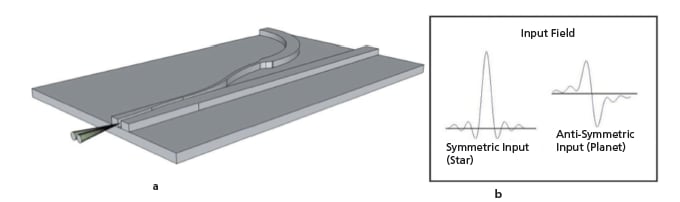
Achromatic nulling technology is a critical component that provides the starlight suppression in interferometer-based observatories. Previously considered space-based interferometers are aimed at approximately 6-to-20-micrometer spectral range. While containing the spectral features of many gases that are considered to be signatures of life, it also offers better planet-to-star brightness ratio than shorter wavelengths.
In the Integrated Optics Achromatic Nuller (IOAN) device, the two beams from the interferometer’s collecting telescopes pass through the same focusing optic and are incident on the input of the nuller.
The dual-input waveguide structure accommodates two modes, while each of the output waveguides accommodates one mode only. At the input, the waveguide structure is symmetric and, therefore, the fundamental mode of the structure at the input is symmetric and the other mode is anti-symmetric. At the output, one of the waveguides is wider than the other, and therefore has a higher effective refractive index. For the light originating from the star, if the interferometer is perfectly balanced, the input field in the focal plane of the focusing optic at the input of the device is symmetric, while for the light field originating from the planet (assuming the exact π phase shift) it is anti-symmetric. Thus, in the two-mode input waveguide the starlight excites the fundamental mode, while the planet light excites the second, anti-symmetric, mode.
This work was done by Alexander Ksendzov of Caltech for NASA’s Jet Propulsion Laboratory. NPO-47834
This Brief includes a Technical Support Package (TSP).
Integrated Optics Achromatic Nuller for Stellar Interferometry
(reference NPO-47834) is currently available for download from the TSP library.
Don't have an account?
Overview
The document presents an overview of the Integrated Optics Achromatic Nuller for Stellar Interferometry developed by NASA's Jet Propulsion Laboratory (JPL). This innovative device aims to enhance exoplanet characterization by improving ground-based interferometry through the use of integrated optics, which simplifies system design and reduces weight and space requirements compared to traditional bulk-optics systems.
The nuller is a dielectric-waveguide-based four-port asymmetric coupler that utilizes the mode-sorting properties of adiabatic asymmetric couplers, allowing for achromatic performance. It is designed to operate within the spectral range of 6.5 to 9.25 micrometers, covering a 36% bandwidth. The device's performance modeling indicates a starlight suppression level of 10^-5 or better across the entire bandwidth, which meets the stringent requirements for exoplanet characterization missions.
The document highlights the advantages of the integrated optics nuller over existing technologies. Previous passive nuller schemes failed to achieve the necessary rejection levels in achromatic mode, while adaptive nullers, although effective, are complex and rely on multiple bulk optics components and electronics. In contrast, the integrated optics nuller is a single piece of glass that eliminates the need for internal alignment, thereby simplifying the overall system.
The nuller is designed to fit within a compact 12.5 x 5 cm rectangle, with a waveguide rib width varying between 9 to 12 micrometers. The modeling results demonstrate the device's performance in relation to device length, wavelength, and waveguide pixilation, with a focus on achieving a 0.05 micrometer pixilation that has been shown to be feasible through experimental methods.
The document also acknowledges the need for further material processing work, although initial processing has been demonstrated by other researchers. The findings and developments are documented under NASA Tech Briefs NPO-47834, with plans for a paper submission to "Applied Optics."
In summary, the Integrated Optics Achromatic Nuller represents a significant advancement in the field of stellar interferometry, offering a more efficient and effective means of characterizing exoplanets by leveraging integrated optics technology. This innovation could play a crucial role in future space missions aimed at exploring Earth-like exoplanets.