Inside this issue
Supplements

Overview
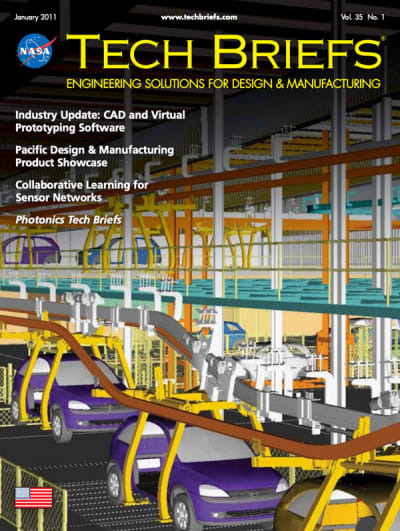
The January 2011 issue of NASA Tech Briefs and Photonics Tech Briefs presents a comprehensive overview of advancements in engineering, technology, and scientific research. This edition is particularly focused on innovations in multiphysics simulation, CAD and virtual prototyping software, and collaborative learning for sensor networks, showcasing how these technologies are transforming industries.
Key Highlights:
-
Multiphysics Simulation in Industry: The issue features a special section on multiphysics simulation, emphasizing its growing importance in engineering and scientific applications. The 2010 Edition of COMSOL News is highlighted, offering 60 pages of case studies that demonstrate how engineers and scientists have successfully utilized COMSOL’s modeling tools to achieve significant results in various fields. This section serves as a valuable resource for professionals looking to understand the practical applications of multiphysics simulation in real-world scenarios.
-
Product Showcases: The magazine includes a product showcase that highlights the latest offerings in fluid handling, laboratory research, industrial processes, and electrochemistry. Notable brands such as Masterflex, Oakton, and Polystat are featured, providing readers with insights into cutting-edge products that can enhance their work efficiency and effectiveness. The catalog is extensive, spanning over 2,600 pages, and is available for free reservation, making it accessible for professionals seeking to stay updated on the latest tools and technologies.
-
Industry Updates: The issue provides updates on CAD and virtual prototyping software, which are essential for modern engineering practices. These tools allow for the creation of detailed digital models that can be tested and refined before physical prototypes are built, significantly reducing development time and costs. The advancements in these software solutions are crucial for industries aiming to innovate rapidly while maintaining high standards of quality and performance.
Collaborative Learning for Sensor Networks: Another significant topic covered is the concept of collaborative learning for sensor networks. This approach emphasizes the importance of integrating various sensors and data sources to enhance decision-making processes in real-time. The article discusses how collaborative learning can lead to improved efficiency and effectiveness in applications ranging from environmental monitoring to industrial automation.
-
Photonics Innovations: The Photonics Tech Briefs section delves into advancements in laser technology, particularly the use of fan-poled crystals to tune Ti:Sapphire lasers. This technology is pivotal for applications requiring precise control of laser output, such as in telecommunications and medical devices. The exploration of these innovations highlights the ongoing research and development efforts in the field of photonics, showcasing the potential for future breakthroughs.
-
Advertisers Index and Free Literature: The magazine also includes an advertisers index, providing readers with easy access to product literature from various companies. By entering the reader service numbers at the Tech Briefs website, readers can request free information on products and services that align with their professional needs. This feature enhances the magazine's utility as a resource for industry professionals.
-
Subscription Information: For those interested in subscribing to NASA Tech Briefs, the issue outlines subscription options, including pricing for both domestic and international readers. This information is crucial for professionals who wish to stay informed about the latest developments in technology and engineering.
-
User-Friendly Navigation: The digital format of the magazine is designed for ease of use, with a navigation bar that allows readers to quickly turn pages, zoom in on content, and access the table of contents. This user-friendly interface enhances the reading experience, making it easier for professionals to find relevant information.
In summary, the January 2011 issue of NASA Tech Briefs and Photonics Tech Briefs serves as a vital resource for engineers, scientists, and industry professionals. It highlights significant advancements in multiphysics simulation, CAD software, and sensor networks, while also showcasing innovative products and technologies. The magazine not only informs readers about the latest trends and tools but also encourages them to engage with the content through free literature and subscription options. Overall, this issue exemplifies the ongoing commitment to advancing technology and fostering collaboration within the engineering and scientific communities.
Features
-
Application Briefs
Tech Briefs
-
Physical Sciences
Onboard Nonlinear Engine Sensor and Component Fault Diagnosis and Isolation Scheme
Cryogenic Caging for Science Instrumentation
Wide-Range Neutron Detector for Space Nuclear Applications
In Situ Guided Wave Structural Health Monitoring System
Multiplexed Energy Coupler for Rotating Equipment
Attitude Estimation in Fractionated Spacecraft Cluster Systems
Method and System for Temporal Filtering in Video Compression Systems
Apparatus for Measuring Total Emissivity of Small, Low-Emissivity Samples
Active Flow Effectors for Noise and Separation Control
High-Sensitivity, Broad-Range Vacuum Gauge Using Nanotubes for Micromachined Cavities
Full Piezoelectric Multilayer-Stacked Hybrid Actuation/ Transduction Systems
-
Manufacturing & Prototyping
Hybrid Composite Cryogenic Tank Structure
Zinc Oxide Nanowire Interphase for Enhanced Lightweight Polymer Fiber Composites
Reliability-Based Design Optimization of a Composite Airframe Component
-
Software
Distributed Aerodynamic Sensing and Processing Toolbox
Mission Services Evolution Center Message Bus
Major Constituents Analysis for the Vehicle Cabin Atmosphere Monitor
Astronaut Health Participant Summary Application
Natural Language Interface for Safety Certification of Safety-Critical Software
Adaption of the AMDIS Method to Flight Status on the VCAM Instrument
-
Materials
Carbon Nanofibers Synthesized on Selective Substrates for Nonvolatile Memory and 3D Electronics
-
Information Sciences
Hazard Detection Software for Lunar Landing
Collaborative Supervised Learning for Sensor Networks
Visual SLAM Using Variance Grid Maps
Modeling Electromagnetic Scattering From Complex Inhomogeneous Objects
Visual Object Recognition and Tracking of Tools
Predicting Spacecraft Trajectories by the WeavEncke Method
An Augmentation of G-Guidance Algorithms
Rapid Calculation of Spacecraft Trajectories Using Efficient Taylor Series Integration
-
Mechanics & Machinery
Plasma Igniter for Reliable Ignition of Combustion in Rocket Engines
-
Semiconductors & ICs
Interface Supports Multiple Broadcast Transceivers for Flight Applications
FPGA Sequencer for Radar Altimeter Applications
SAD5 Stereo Correlation Line-Striping in an FPGA
Miniature Sapphire Acoustic Resonator — MSAR
Process-Hardened, Multi-Analyte Sensor for Characterizing Rocket Plume Constituents
-
Electronics & Computers
Network-Capable Application Process and Wireless Intelligent Sensors for ISHM
Products
-
Briefs
Wide-Field Optic for Autonomous Acquisition of Laser Link
Method for Implementing Optical Phase Adjustment
Multiple-Zone Diffractive Optic Element for Laser Ranging Applications
Simplified Architecture for Precise Aiming of a Deep-Space Communication Laser Transceiver