

Previous oil containment booms have an open top that allows natural gas to escape, and have significant oil leakage due to wave action. Also, a subsea pyramid oil trap exists, but cannot move relative to moving oil plumes from deepsea oil leaks.
A second design version has a flexible pyramid cover that is attached by lines to ballast on the ocean floor. This is similar to fixed, metal pyramid oil capture devices in the Santa Barbara Channel off the coast of California. The ballast lines for the improved design, however, would have winches that can move the pyramid to always be located above the oil and gas plume.
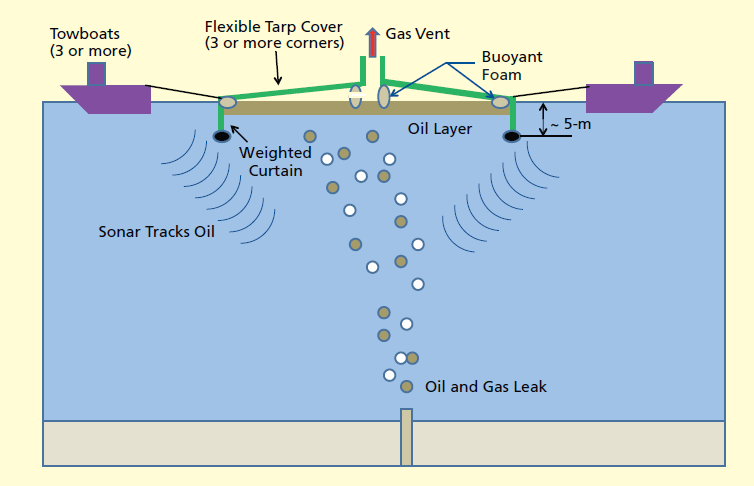
A third design is a combination of the first two. It uses a submerged pyramid to trap oil, but has no anchor and uses boats to locate the trap. It has ballast weights located along the bottom of the tarp and/or at the corners of the trap.
The improved floating oil-spill containment device has a large floating boom and weighted skirt surrounding the oil and gas entrapment area. The device is triangular (or more than three sides) and has a flexible tarp cover with a raised gas vent area. Boats pull on the apex of the triangles to maintain tension and to allow the device to move to optimum locations to trap oil and gas. The gas is retrieved from a higher buoyant part of the tarp, and oil is retrieved from the floating oil layer contained in the device.
These devices can be operated in relatively severe weather, since waves will break over the devices without causing oil leaking. Also, natural gas is entrapped and can be retrieved. All designs can use sonar to locate the moving oil plume, and then be relocated by using boats or winches to move the oil trapping devices. These devices can be constructed of treated, non-permeable DuPont Kevlar cloth (or similar material).
This work was done by Jack A. Jones of Caltech for NASA’s Jet Propulsion Laboratory. NPO-47679
This Brief includes a Technical Support Package (TSP).
Floating Oil-Spill Containment Device
(reference NPO-47679) is currently available for download from the TSP library.
Don't have an account?
Overview
The document is a Technical Support Package from NASA's Jet Propulsion Laboratory (JPL) detailing the Floating Oil-Spill Containment Device, referenced as NPO-47679. It outlines advancements in technology aimed at addressing environmental challenges, specifically the containment and retrieval of oil spills in aquatic environments.
The primary focus of the document is on innovative containment devices designed to effectively manage oil spills. These devices utilize flexible tarp covers, which can be deployed in various configurations, including movable pyramid designs and umbrella covers. The designs incorporate features such as weighted corners and ballast lines to enhance stability and effectiveness in turbulent water conditions. The devices are engineered to be relatively immune to wave action, allowing them to track and retrieve oil and gas efficiently.
Key components of the containment devices include sonar technology for tracking oil flow, which aids in the proper positioning of winches and tarp lines. The document mentions the use of tow boats, which are essential for maneuvering the containment devices into position and maintaining their effectiveness during spill events. The devices can operate at significant depths, with some designs capable of functioning at depths of up to 500 meters.
The document also highlights the importance of minimizing the use of oil dispersants, advocating for a narrower oil plume to enhance retrieval efforts. The technology is positioned as a significant advancement in spill response, with the potential for broader applications beyond aerospace, including commercial and environmental sectors.
Additionally, the document emphasizes compliance with U.S. export regulations and the proprietary nature of the information contained within. It encourages collaboration and further inquiries through the NASA Innovative Partnerships Program, indicating a commitment to sharing knowledge and technology for the benefit of environmental management.
In summary, the Technical Support Package presents a comprehensive overview of NASA's efforts to develop effective oil spill containment technologies, showcasing innovative designs and methodologies that leverage aerospace advancements to address critical environmental issues. The document serves as a resource for understanding the capabilities and applications of these technologies in real-world scenarios.











