

Software has been developed to perform a number of functions essential to autonomous operation in the Autonomous Sciencecraft Experiment (ASE), which is scheduled to be demonstrated aboard a constellation of three spacecraft, denoted TechSat 21, to be launched by the Air Force into orbit around the Earth in January 2006. A prior version of this software was reported in "Software for an Autonomous Constellation of Satellites" (NPO-30355), NASA Tech Briefs, Vol. 26, No. 11 (November 2002), page 44.
The software includes the following components:
- Algorithms to analyze image data, generate scientific data products, and detect conditions, features, and events of potential scientific interest;
- A program that uses component-based computational models of hardware to analyze anomalous situations and to generate novel command sequences, including (when possible) commands to repair components diagnosed as faulty;
- A robust-execution-management component that uses the Spacecraft Command Language (SCL) software to enable event-driven processing and low-level autonomy; and
- The Continuous Activity Scheduling, Planning, Execution, and Replanning (CASPER) program for replanning activities, including downlink sessions, on the basis of scientific observations performed during previous orbit cycles.
This program was written by Robert Sherwood, Russell Knight, Gregg Rabideau, Steve Chien, Daniel Tran, Benjamin Cichy, Rebecca Castaño, Timothy Stough, and Ashley Davies of Caltech for NASA's Jet Propulsion Laboratory.
This software is available for commercial licensing. Please contact Don Hart of the California Institute of Technology at (818) 393-3425. Refer to NPO-30784.
This Brief includes a Technical Support Package (TSP).
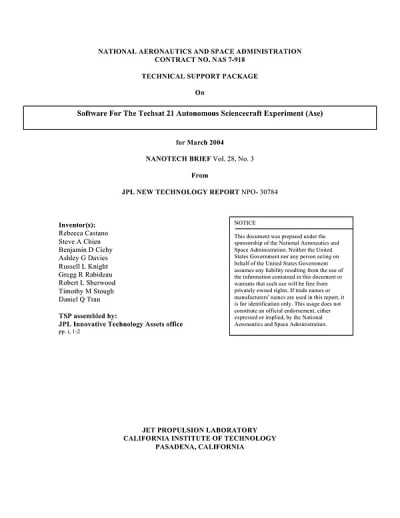
The TechSat 21 Autonomous Sciencecraft Experiment
(reference NPO30784) is currently available for download from the TSP library.
Don't have an account?
Overview
The document outlines the TechSat 21 Autonomous Sciencecraft Experiment (ASE), a project developed by NASA's Jet Propulsion Laboratory (JPL) aimed at enhancing autonomous operations in space. Scheduled for launch in January 2006, the ASE will be demonstrated aboard a constellation of three spacecraft, known as TechSat 21, deployed by the Air Force.
The ASE software is designed to significantly improve the science return from space missions through advanced onboard capabilities. Key features of the software include:
-
Onboard Science Algorithms: These algorithms analyze image data to generate scientific products and detect conditions or features of potential scientific interest. They enable the spacecraft to autonomously identify "interesting" events and changes in the environment.
-
Model-Based Mode Identification and Execution (MI-R): This component utilizes component-based hardware models to assess anomalous situations. It can generate novel command sequences and, when feasible, commands to repair diagnosed faults, enhancing the spacecraft's resilience and operational efficiency.
-
Robust Execution Management: The software employs the Spacecraft Command Language (SCL) to facilitate event-driven processing and low-level autonomy. This allows the spacecraft to respond dynamically to changing conditions and requirements.
-
Continuous Activity Scheduling, Planning, Execution, and Replanning (CASPER): This planner is crucial for adapting the spacecraft's activities based on scientific observations made during previous orbit cycles. It enables the spacecraft to replan downlink sessions and other activities autonomously, optimizing the use of its resources and time.
The document also credits the development team, which includes notable contributors from Caltech and JPL, and mentions that the software is available for commercial licensing.
The ASE represents a significant advancement in spacecraft autonomy, promising to open new avenues in planetary science, space physics, and Earth science. By enabling intelligent downlink selection and autonomous retargeting, the ASE aims to achieve scientific objectives that would be unattainable without such technology.
Overall, the TechSat 21 ASE is a pioneering effort in the field of autonomous space exploration, showcasing the potential of onboard artificial intelligence to enhance scientific discovery and operational efficiency in space missions.









