The Autonomous Sciencecraft Constellation (ASC) software has been developed for Techsat-21 — a group of small satellites, to be launched by the Air Force Research Laboratory in 2004, intended to demonstrate the feasibility of groups of satellites cooperating in the performance of tasks. The task in this initial application will be scientific radar observations of the Earth, using the satellites flying in precise formation to synthesize a wide-aperture antenna. The ASC software will enable Techsat-21 to function with a high degree of autonomy, thereby reducing the utilization of limited communication bandwidth and reducing the need for labor-intensive sequencing of commands and analysis of scientific data on the ground. The software will provide onboard scientific analysis of image data, replanning, robust execution of plans, model-based estimation and control, and formation-flying control to increase science return through a combination of intelligent selection of downlinks and autonomous retargeting on the basis of “interesting” features in the scientific data.
This program was written by Robert Sherwood, Russell Knight, Gregg Rabideau, Steve Chien, Daniel Tran, Barbara Engelhardt, Rebecca Castaño, Timothy Stough, Michael Burl, and Ashley Davies of Caltech for NASA’s Jet Propulsion Laboratory.
This software is available for commercial licensing. Please contact Don Hart of the California Institute of Technology at (818) 393- 3425. Refer to NPO-30355.
This Brief includes a Technical Support Package (TSP).
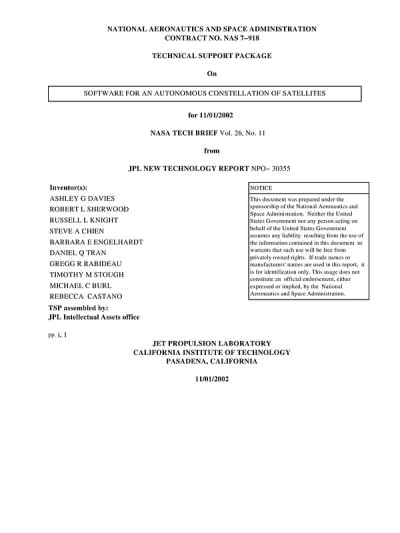
Software for an Autonomous Constellation of Satellites
(reference NPO-30355) is currently available for download from the TSP library.
Don't have an account?
Overview
The document discusses the development of the Autonomous Sciencecraft Constellation (ASC) software, created for the Techsat-21 satellite constellation, which is scheduled for launch by the Air Force Research Laboratory in 2004. The primary goal of this initiative is to demonstrate the feasibility of multiple satellites working collaboratively to perform scientific tasks, specifically through radar observations of Earth.
The ASC software is designed to enhance the autonomy of the Techsat-21 satellites, thereby minimizing the need for extensive communication bandwidth and reducing the labor-intensive processes associated with command sequencing and scientific data analysis on the ground. Key features of the ASC software include onboard scientific analysis of image data, replanning capabilities, robust execution of plans, model-based estimation and control, and formation-flying control. These functionalities aim to optimize the science return by intelligently selecting data downlinks and autonomously retargeting observations based on identified "interesting" features in the scientific data.
The document highlights the novelty of the ASC project, emphasizing its potential to significantly improve scientific outcomes in planetary science, space physics, and Earth science. The software addresses several challenges faced in satellite operations, including limited downlink bandwidth, the need for rapid responses to dynamic scientific events, spacecraft coordination, recovery from anomalies, and the labor-intensive nature of ground-based sequencing and analysis.
The ASC software was developed by a team from Caltech, including notable contributors such as Robert Sherwood, Russell Knight, and Steve Chien, among others. The project is part of a broader effort by NASA's Jet Propulsion Laboratory, which operates under a contract with the National Aeronautics and Space Administration (NASA).
Additionally, the document includes a disclaimer stating that references to specific commercial products or services do not imply endorsement by the U.S. Government or the Jet Propulsion Laboratory. The ASC software is available for commercial licensing, with contact information provided for inquiries.
In summary, the ASC software represents a significant advancement in satellite technology, enabling autonomous operations that promise to enhance scientific research capabilities in space.