

CFDP is a computer program that implements the CCSDS (Consultative Committee for Space Data Systems) File Delivery Protocol, which is an international standard for automatic, reliable transfers of files of data between locations on Earth and in outer space. CFDP administers concurrent file transfers in both directions, delivery of data out of transmission order, reliable and unreliable transmission modes, and automatic retransmission of lost or corrupted data by use of one or more of several lost-segment-detection modes. The program also implements several data-integrity measures, including file checksums and optional cyclic redundancy checks for each protocol data unit. The metadata accompanying each file can include messages to users' application programs and commands for operating on remote file systems.
This program was written by Kathleen Rundstrom, Son Q. Ho, Michael Levesque, Felicia Sanders, Scott Burleigh, and John Veregge of Caltech for NASA's Jet Propulsion Laboratory. For further information, access the Technical Support Package (TSP) free on-line at www.techbriefs.com/tsp under the Software category.
This software is available for commercial licensing. Please contact Don Hart of the California Institute of Technology at (818) 393-3425. Refer to NPO-40247.
This Brief includes a Technical Support Package (TSP).
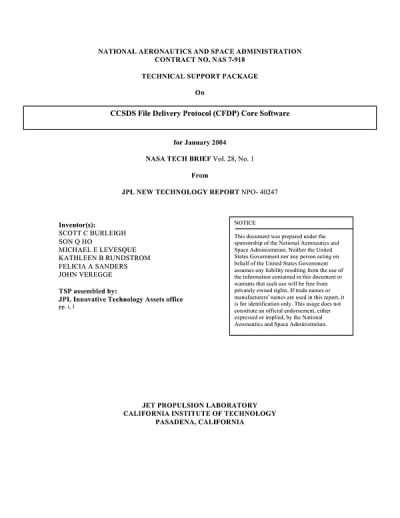
Software Implements a Space-Mission File-Transfer Protocol
(reference NPO40247) is currently available for download from the TSP library.
Don't have an account?
Overview
The document discusses the CCSDS File Delivery Protocol (CFDP) Core Software developed by NASA's Jet Propulsion Laboratory (JPL) for reliable file transfers between Earth and space. CFDP is an international standard established by the Consultative Committee for Space Data Systems (CCSDS) that enables automatic and dependable file transfers, crucial for deep space missions.
The software is designed to handle concurrent file transfers in both directions, allowing for the delivery of data out of transmission order. It supports both reliable and unreliable transmission modes and includes automatic retransmission of lost or corrupted data through various lost segment detection methods. To ensure data integrity, CFDP implements several measures, including file checksums and optional cyclic redundancy checks (CRCs) for each protocol data unit. Additionally, the metadata accompanying each file can contain messages for user applications and commands for managing remote file systems.
Notably, this implementation of CFDP represents the first use of a standard file transfer protocol in deep space missions, marking a significant milestone in the development of an interplanetary network for future space exploration. The software is being integrated into the Deep Impact Project's flight software, which operates on the VxWorks operating system, and will also be utilized in the UNIX-based AMMOS Ground System to support the Deep Impact Mission and future missions like the Mars Reconnaissance Orbiter (MRO) and the Mission Data System (MDS). Furthermore, JPL's CFDP software is already in use at the Applied Physics Laboratory (APL) of Johns Hopkins University for the Messenger Project Ground System, successfully transferring files between the ground system and flight software in a testbed environment.
The document also provides information about the team of developers who created the software, including Kathleen Rundstrom, Son Q. Ho, Michael Levesque, Felicia Sanders, Scott Burleigh, and John Veregge from Caltech. It mentions that the software is available for commercial licensing, with contact details provided for inquiries.
Overall, the CFDP software represents a significant advancement in space communication technology, enhancing the capability for reliable data transfer in the challenging environment of deep space missions.









