

The State Analysis Database Tool software establishes a productive environment for collaboration among software and system engineers engaged in the development of complex interacting systems. The tool embodies State Analysis, a model-based system engineering methodology founded on a state-based control architecture (see figure). A state represents a momentary condition of an evolving system, and a model may describe how a state evolves and is affected by other states. The State Analysis methodology is a process for capturing system and software requirements in the form of explicit models and states, and defining goal-based operational plans consistent with the models. Requirements, models, and operational concerns have traditionally been documented in a variety of system engineering artifacts that address different aspects of a mission's lifecycle. In State Analysis, requirements, models, and operations information are State Analysis artifacts that are consistent and stored in a State Analysis Database. The tool includes a back-end database, a multi-platform front-end client, and Web-based administrative functions. The tool is structured to prompt an engineer to follow the State Analysis methodology, to encourage state discovery and model description, and to make software requirements and operations plans consistent with model descriptions.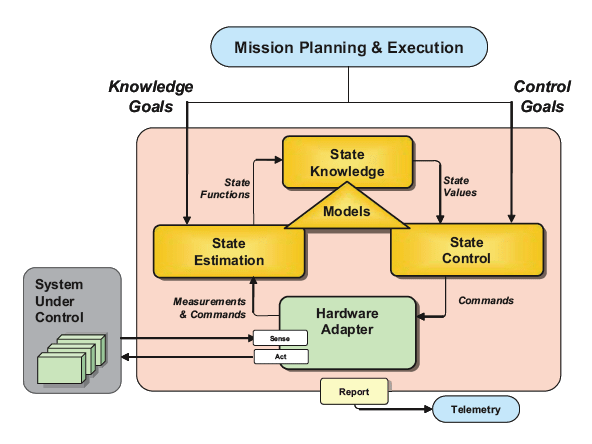
This program was written by Robert Rasmussen and Matthew Bennett of Caltech for NASA's Jet Propulsion Laboratory. For further information, access the Technical Support Package (TSP) free online at www.techbriefs.com/tsp under the Software category.
The software used in this innovation is available for commercial licensing. Please contact Karina Edmonds of the California Institute of Technology at (626) 395-2322. Refer to NPO-42869.
This Brief includes a Technical Support Package (TSP).
State Analysis Database Tool
(reference NPO-42869) is currently available for download from the TSP library.
Don't have an account?
Overview
The document is a Technical Support Package for the State Analysis Database Tool, referenced in NASA Tech Briefs NPO-42869. It aims to disseminate results from aerospace-related developments that have broader technological, scientific, or commercial applications. The document emphasizes the importance of effective systems engineering in the context of robotic exploration spacecraft, particularly in the development of the Mission Data System (MDS) software architecture at the Jet Propulsion Laboratory (JPL).
Key highlights include the introduction of a mechanism for reactive coordination of activities, which contrasts with more deliberative, pre-planned coordination. This reactive approach is essential for tasks such as rover driving and attitude control, where real-time adjustments are necessary. The mechanism, termed delegation, allows one state variable to transfer control to another, facilitating more dynamic responses during operations.
The document also discusses the construction of collaboration diagrams using Unified Modeling Language (UML), which visually represent the interconnections and information flow among software components. These diagrams are informed by state, measurement, and command models, ensuring that the software design is closely aligned with the system's operational requirements.
A significant feature of the State Analysis process is the consolidation of various systems engineering artifacts into a single State Analysis Database. This database captures essential information, including hardware functional requirements, failure modes, command dictionaries, and telemetry data. By centralizing this information, the database enhances the validation and consistency checking of control system requirements against state effects models of the environment and hardware.
The document underscores the necessity for a direct relationship between models and software design, minimizing the need for translation and ensuring that the software accurately reflects the system's operational needs. The MDS architecture is designed to support multi-mission operations, integrating all aspects of a mission from development to flight and ground operations.
In summary, the document provides a comprehensive overview of the State Analysis Database Tool, highlighting its role in improving the design and operation of complex aerospace systems through effective modeling, coordination, and software architecture. It serves as a resource for systems engineers and researchers interested in advancing aerospace technology.











