software prototype of BEAM (Beaconbased Exception Analysis for Multimissions) and successfully tested its operation in flight onboard a NASA research aircraft. BEAM (see NASA Tech Briefs, Vol. 26, No. 9; and Vol. 27, No. 3) is an ISHM (Integrated Systems Health Management) technology that automatically analyzes sensor data and classifies system behavior as either nominal or anomalous, and further characterizes anomalies according to strength, duration, and affected signals. BEAM (see figure) can be used to monitor a wide variety of physical systems and sensor types in real time. In this series of tests, BEAM monitored the engines of a Dryden Flight Research Center F-18 aircraft, and performed onboard, unattended analysis of 26 engine sensors from engine startup to shutdown. The BEAM algorithm can detect anomalies based solely on the sensor data, which includes but is not limited to sensor failure, performance degradation, incorrect operation such as unplanned engine shutdown or flameout in this example, and major system faults. BEAM was tested on an F- 18 simulator, static engine tests, and 25 individual flights totaling approximately 60 hours of flight time. During these tests, BEAM successfully identified planned anomalies (in-flight shutdowns of one engine) as well as minor unplanned anomalies (e.g., transient oiland fuel-pressure drops), with no false alarms or suspected false-negative results for the period tested. BEAM also detected previously unknown behavior in the F-18 compressor section during several flights. This result, confirmed by direct analysis of the raw data, serves as a significant test of BEAM's capability.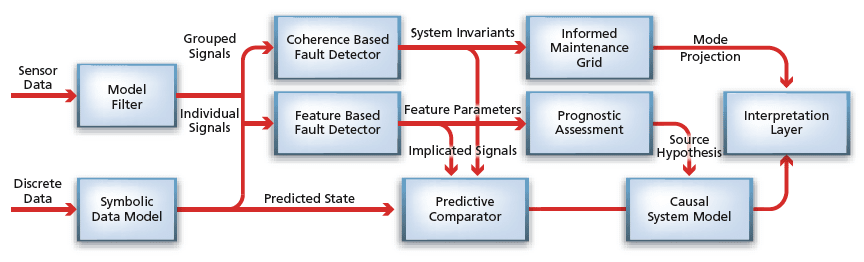
This program was written by Ryan Mackey, Raffi Tikidjian, Mark James, and David Wang of Caltech for NASA's Jet Propulsion Laboratory. For further information, access the Technical Support Package (TSP) free online at www.techbriefs.com/tsp under the Software category.
This software is available for commercial licensing. Please contact Karina Edmonds of the California Institute of Technology at (626) 395-2322. Refer to NPO-42727.
This Brief includes a Technical Support Package (TSP).
Flight-Tested Prototype of BEAM Software
(reference NPO-42727) is currently available for download from the TSP library.
Don't have an account?
Overview
The document is a Technical Support Package for the Flight-Tested Prototype of BEAM (Bio-Environmental Assessment and Monitoring) Software, identified by NASA Tech Brief NPO-42727. It is produced by NASA's Jet Propulsion Laboratory (JPL) in Pasadena, California, under the auspices of the National Aeronautics and Space Administration (NASA). The primary purpose of this document is to disseminate information regarding aerospace-related developments that have potential applications beyond their original context, thereby supporting the Commercial Technology Program of NASA.
The Technical Support Package includes documentation that outlines the capabilities and functionalities of the BEAM software prototype, which has been flight-tested. This software is designed to assist in bio-environmental assessments, which are crucial for various aerospace missions, particularly those involving human spaceflight. The software's development is part of NASA's broader efforts to enhance technology that can be utilized in both scientific and commercial sectors.
The document emphasizes the importance of compliance with U.S. export regulations, indicating that the information may contain proprietary data from Caltech/JPL. It also includes a disclaimer stating that neither the U.S. Government nor any representatives assume liability for the use of the information provided, nor do they guarantee that such use will be free from privately owned rights.
For those seeking further assistance or information, the document provides contact details for the NASA Scientific and Technical Information (STI) Program Office, including a website link, a physical address, and contact information for the NASA STI Help Desk. This resource is intended to facilitate access to a wide range of publications and research related to aerospace technology.
Overall, the Technical Support Package serves as a comprehensive resource for understanding the BEAM software's capabilities and its relevance to ongoing and future aerospace missions. It highlights NASA's commitment to innovation and collaboration in the field of aerospace technology, aiming to foster partnerships that can leverage these advancements for broader applications in science and industry.