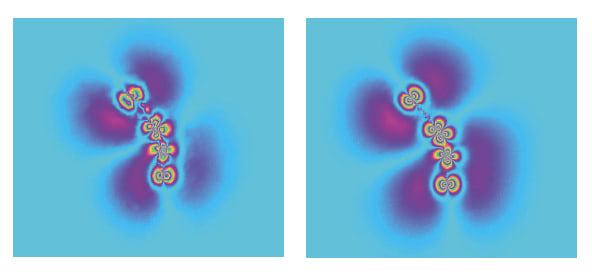
GeoFEST(P) is a computer program written for use in the QuakeSim project, which is devoted to development and improvement of means of computational simulation of earthquakes. GeoFEST(P) models interacting earthquake fault systems from the fault-nucleation to the tectonic scale. The development of GeoFEST(P) has involved coupling of two programs: GeoFEST and the Pyramid Adaptive Mesh Refinement Library. GeoFEST is a message-passinginterface- parallel code that utilizes a finite-element technique to simulate evolution of stress, fault slip, and plastic/ elastic deformation in realistic materials like those of faulted regions of the crust of the Earth. The products of such simulations are synthetic observable time-dependent surface deformations on time scales from days to decades. Pyramid Adaptive Mesh Refinement Library is a software library that facilitates the generation of computational meshes for solving physical problems. In an application of GeoFEST(P), a computational grid can be dynamically adapted as stress grows on a fault. Simulations on workstations using a few tens of thousands of stress and displacement finite elements can now be expanded to multiple millions of elements with greater than 98-percent scaled efficiency on over many hundreds of parallel processors (see figure).
This work was done by Andrea Donnellan, Jay Parker, Gregory Lyzenga, Michele Judd, P. Peggy Li, Charles Norton, Edwin Tisdale, and Robert Granat of Caltech for NASA's Jet Propulsion Laboratory. For further information, access the Technical Support Package (TSP) free on-line at www.techbriefs.com/tsp under the Software category.
This software is available for commercial licensing. Please contact Karina Edmonds of the California Institute of Technology at (626) 395-2322. Refer to NPO-41079.
This Brief includes a Technical Support Package (TSP).
Progress in Computational Simulation of Earthquakes
(reference NPO-41079) is currently available for download from the TSP library.
Don't have an account?
Overview
The document titled "Progress in Computational Simulation of Earthquakes" presents advancements in the simulation of seismic events, particularly through the use of the GeoFEST(P) code, developed at NASA's Jet Propulsion Laboratory. GeoFEST is an MPI-parallel code capable of simulating complex geological processes over extended periods, specifically focusing on postseismic deformation in regions like Southern California. The software can handle simulations involving multiple interacting faults, utilizing up to 1.4 million finite elements and running on various computing systems with up to 512 processors.
The introduction highlights the significance of the finite element technique in modeling heterogeneous faulted regions of the Earth’s crust, allowing for detailed simulations of stress evolution, fault slip, and elastic/plastic processes in realistic materials. The simulations produce synthetic observable surface deformations that can be analyzed over time scales ranging from days to decades. The document emphasizes the integration of GeoFEST into the QuakeSim portal, which enables non-experts to specify and solve problems through a user-friendly web interface, displaying results alongside Landsat imagery and digital elevation models.
Performance results indicate that the parallel version of GeoFEST has achieved excellent efficiency across various computing systems. The document details a case study of the 1992 Landers fault event, showcasing the improvements in visual quality and accuracy when increasing the mesh density from 82,000 elements on four processors to 1.4 million elements on 64 processors. The iterative solve, which is the most computationally intensive part of the calculation, demonstrates consistent performance metrics across scaled problem sizes.
Figures included in the document illustrate the surface displacement from the Landers model, highlighting both coseismic and postseismic deformations. The document also discusses the computational and communication dynamics involved in the iterative solve, showing that computation significantly outweighs communication, leading to a well-balanced calculation.
The collaborative development approach, termed "Extreme Programming," is noted for its effectiveness in minimizing errors and enhancing the software's quality through interactive team contributions. Overall, the document underscores the importance of parallelizing GeoFEST for advancing earthquake simulation capabilities, with future plans for even larger models and adaptive mesh refinement to improve resolution in critical areas.