

The water landing of a craft like the Orion Crew Module is a very complex and changeable event, subject to the dynamics of the vehicle’s structure and sub-structures, such as its heat shield and atmospheric and water conditions. To maintain the spacecraft’s structural integrity and increase safety of the crew, a clearer understanding of the dynamic loads generated during water impact was required.
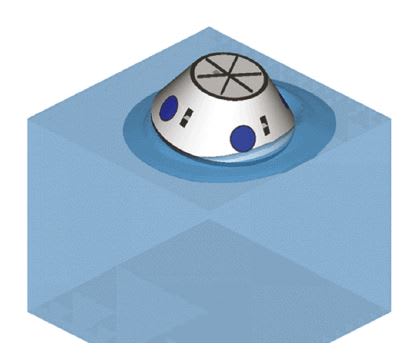
NASA worked with Altair’s Product - Design group to develop the simulation model, working as part of the larger NESC assessment team. NASA built a full-scale boilerplate Crew Module to perform the required physical testing. The Crew Module, instrumented with several data-collecting devices such as accelerometers, strain gauges, an inertial measurement unit, and pressure sensors, was primarily built from steel with reinforcements so that it could be analytically treated as a rigid body.
The team placed photogrammetric targets on the outside surfaces to accurately measure the Crew Module trajectories, along with high-speed video cameras at strategic locations. At a still, deep, freshwater lake, NESC performed more than 60 physical drops of the module at slightly different impact angles and velocities. The raw data from each drop test was supplied to the simulation team to aid with the correlation of the FEA models.
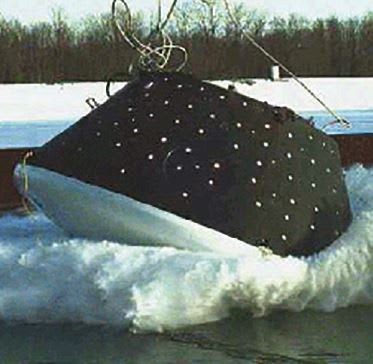
The team then analyzed the sensitivity of parameters such as interface stiffness, mesh density, fluid pressure distribution, and boundary conditions, each in relation to acceleration data. The analysis showed that mesh density proved by far to be the parameter that most significantly influenced the correlation of the simulation with physical tests. The engineers created a matrix consisting of 20 separate models with different combinations of mesh density for the Crew Module and the fluid mesh. They discovered a very good correlation when applying the smallest mesh dimension to the fluid mesh in three directions, and only varying the Crew Module mesh size to be the same or larger than the fluid mesh dimension.
HyperWorks and HyperMesh simulation software
Altair
Troy, MI
248-614-2400
www.altair.com
For Free Info Click Here











