
Inside this issue
Supplements
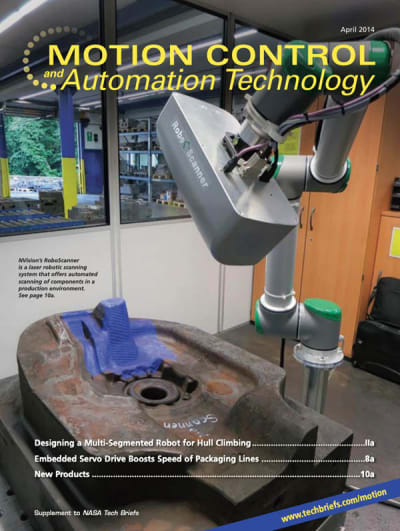
Overview
The April 2014 issue of NASA Tech Briefs and Motion Control and Automation Technology presents a comprehensive overview of advancements in technology, particularly focusing on automation, robotics, and motion control systems. This edition highlights several key innovations and trends that are shaping the future of these fields.
Key Features and Innovations:
-
Design Tools for Automakers: The issue opens with a discussion on design tools that are helping automakers navigate the complexities of modern vehicle design. These tools are essential for enhancing efficiency and innovation in automotive engineering, allowing for better integration of technology and design.
-
Multi-Segmented Robots: A significant feature is the exploration of multi-segmented robots designed for hull climbing. These robots are engineered to navigate complex surfaces, making them ideal for applications in shipbuilding and maintenance. The design focuses on flexibility and adaptability, enabling the robots to perform tasks in challenging environments.
-
Embedded Servo Drives: Another highlight is the introduction of embedded servo drives that boost the speed and efficiency of packaging lines. These drives are crucial for automating processes in manufacturing, allowing for faster production rates and improved precision in packaging operations.
Health Monitoring for Athletes: The issue also covers an innovative astronaut monitor that tracks the health of athletes. This technology is not only applicable in space missions but also has potential uses in sports medicine and fitness, providing real-time data on physiological parameters.
-
Robotic Scanning Systems: Featured prominently is NVision’s RoboScanner, a laser robotic scanning system that automates the scanning of components in production environments. This technology enhances quality control and precision in manufacturing, allowing for detailed inspections and measurements.
-
New Products and Technologies: The magazine includes a section dedicated to new products added daily, showcasing the latest innovations in the field. This section serves as a valuable resource for professionals looking to stay updated on cutting-edge technologies and tools available in the market.
-
Industry Events: The issue previews the SAE World Congress, an important event for industry professionals to gather, share knowledge, and discuss the future of automotive and aerospace technologies. This event is a platform for networking and learning about the latest research and developments in the field.
-
Advertisers Index: The magazine concludes with an advertisers index, providing readers with access to product literature and additional resources. This section is designed to facilitate connections between readers and companies offering relevant technologies and solutions.
Conclusion: The April 2014 issue of NASA Tech Briefs and Motion Control and Automation Technology serves as a vital resource for engineers, researchers, and industry professionals. It encapsulates the latest advancements in automation and motion control, emphasizing the importance of innovation in driving efficiency and effectiveness in various applications. The insights provided in this edition not only highlight current trends but also set the stage for future developments in technology, making it a must-read for anyone involved in these dynamic fields.
Overall, this issue reflects the ongoing evolution of technology and its impact on industries ranging from automotive to aerospace, showcasing how advancements in design, robotics, and automation are paving the way for a more efficient and technologically advanced future.
Features
-
Technologies
-
Application Briefs
Water Impact Simulation Ensures Safer Landing for NASA Astronauts
Thrusters Support Communications Satellite Launch
-
Who's Who
Dr. Vadim Smelyanskiy, Principal Scientist, Ames Research Center, Moffett Field, CA
Kenneth Dudley, Senior Researcher, Langley Research Center, Hampton, VA
Tech Briefs
-
Physical Sciences
Laser Spider Web Sensor Used With Portable Handheld Devices
High-Energy Lithium Flow Cells With Sulfur Cathodes for Transportation Applications
Physical Causes of Extremely Low Geomagnetic Activity
Green PCB Removal From Sediment Systems (GPRSS)
Internalization of Non-Spherical Particles
System for Observing Dynamic Atmospheric Phenomena
-
Manufacturing & Prototyping
Self-Aligning Lug for Adapting Carbon Fiber Rods to a Bolted Metallic Connection
-
Software
Weekly Status Reporting & Approval Application Revision 2
CoolSPICE: SPICE Simulator for Cryogenic Electronics
-
Materials
Dispersion of Carbon Nanotubes Into Polymer Matrices to Produce Unique Properties
Carbon Nanotube Growth Density Control
Long-Life, Hydrophilic, Antimicrobial Coating for Condensing Heat Exchangers
Opposed Pad Gecko Adhesive Gripper for On-Off Omnidirectional Anchoring/Gripping in Orbit
Complex Geometry Multi-Use Coatings for Abrasion Prevention, Wear Resistance, and Lunar Dust Removal
-
Information Sciences
Adaptive Periodic-Correlation Algorithm for Shack-Hartmann Wavefront Sensing
Atmospheric Turbulence Modeling for Aero Vehicles
Optimization of OT-MACH Filter Generation for Target Recognition
A Decision Support Tool to Assess Upper-Level Winds for Space Launch
Change Detection in Orbital Images Using Relative Landmark Graphs
-
Mechanics & Machinery
Electrically Conductive, Failure-Resistant Tethers
Acoustic Mechanical Feedthroughs for Producing Work Across a Structure
Porous Media Jacket for Use in Regeneratively Cooled Rocket Engines
-
Electronics & Computers
Dual-Channel Electromechanical Shutter Driver (ESD)
Sub-Nanosecond, Compact, Low-Power Time-Interval Measurement
Improvised Diagnostic Strategy for High-Side Switch Power Stage
-
Sensors/Data Acquisition
In Situ Health Monitoring of Piezoelectric Sensors
Wireless Sensor Node for Autonomous Monitoring and Alerts in Remote Environments
Capacitive Humidity Sensors Using Highly Durable Polyimide Membrane
Products
-
Applications