

A powerful tool in understanding the role that greenhouse gasses play in climate change would be real-time data from laser chemical sensors providing concentrations and locations of key gasses. The adoption and widespread use of smart mobile phones is an ideal platform on which to create an international web of data collection devices. Because long path lengths often mean more space, many precision instruments are too large to be useful anywhere outside of a lab or test bench environment. A more compact method of achieving long path lengths is needed to advance the field of trace chemical detection.
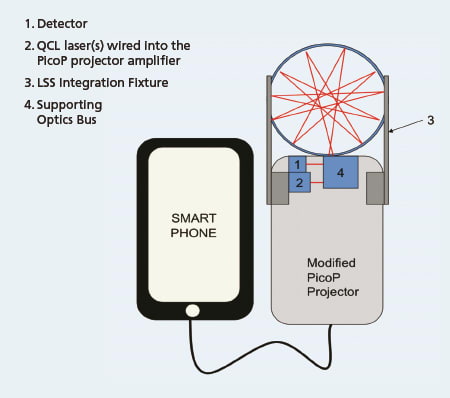
Such cylinders could be made small enough to be integrated into an attachment for use with smart phones, and run via a smart phone application for the purpose of in situ data acquisition of the location and amounts of greenhouse gasses. Such information could be an important step towards building a web to verify and validate data that will be collected by future NASA missions whose goal will be to monitor carbon. Other key applications will include monitoring of indoor chemical pollution.
The reflecting ring operates on the same principle as the Herriott cell. The difference exists in the mirror, which does not have to be optically aligned and which has a relatively large, internal surface area that lends itself to either open air or evacuated spectroscopic measurements. Benefits of the reflecting ring come when size constraints reduce the size of the reflecting system. The large surface area in a small package allows long path lengths to be achieved within a minimum volume. Since the ring simultaneously forms the mirror and support structure, there is no mismatch of coefficients of thermal expansion as is typically found with conventional Herriott cell configurations.
Having the optics cut from a single aluminum billet is ideal for achieving precision measurements from a mobile device. A smart phone attachment would allow for widespread use because of the already existing web of mobile device users. Through the use of advanced integrated electronics and MEMS (microelectromechanical systems) technology, it will eventually be able to miniaturize the optical, mechanical, and electronics into a compact package to fit directly into the mobile device.
A ground-based network of chemical detection devices would provide verification and validation of data from current and future NASA missions. Such a network will also enhance the tools and the information that NASA Earth scientists use to create accurate models of how Earth’s atmosphere reacts to greenhouse gasses.
This work was done by David C. Scott, Alexander Ksendzov, Warren P. George, Richard L. Baron, James A. Smith, and Abdullah S. Aljabri of Caltech; and Joel M. Steinkraus and Rudi M. Bendig of the California Polytechnic State University for NASA’s Jet Propulsion Laboratory.
In accordance with Public Law 96-517, the contractor has elected to retain title to this invention. Inquiries concerning rights for its commercial use should be addressed to:
Innovative Technology Assets Management
JPL
Mail Stop 321-123
4800 Oak Grove Drive
Pasadena, CA 91109-8099
E-mail: This email address is being protected from spambots. You need JavaScript enabled to view it.
Refer to NPO-47738.
This Brief includes a Technical Support Package (TSP).
Laser Spider Web Sensor Used With Portable Handheld Devices
(reference NPO-47738) is currently available for download from the TSP library.
Don't have an account?
Overview
The document discusses the development of the Laser Spider Web Sensor (LSS), a portable laser system designed for the detection of greenhouse gases, which are critical for monitoring the global carbon cycle and climate change. This initiative is supported by various governmental agencies, including the Department of Energy (DOE), the Environmental Protection Agency (EPA), and NASA, emphasizing the importance of understanding complex biological and environmental systems.
The LSS utilizes diode laser technology, which allows for precise measurements of gas concentrations, including O2, CO2, CO, and H2O, in various environments. The sensors are designed to be portable, enhancing their usability in different settings, such as workplaces, to ensure safety and comfort. The document highlights the evolution of the Herriott cell used in these sensors, which has been adapted from designs used in high-altitude reconnaissance and planetary exploration.
A key feature of the LSS is its integration with portable devices like smartphones and laptops. The Microvision SHOWWX™ Laser Pico Projector serves as a foundational platform for the LSS, enabling it to condense multiple laser components into a compact, handheld device. The specifications for the LSS include a height of 14mm, width of 60mm, length of 118mm, and a weight of 122g, with a battery life of approximately 10 hours.
The document also outlines the architecture for the second generation of the handheld detection system, which is designed to be slightly larger than a smartphone when closed and the size of a small book when in use. This design aims to accommodate the necessary components while maintaining portability.
Overall, the LSS represents a significant advancement in environmental monitoring technology, providing a practical solution for real-time detection of greenhouse gases. The document serves as a technical support package under NASA's Commercial Technology Program, aiming to disseminate aerospace-related developments with broader technological and commercial applications. For further inquiries or information, the document provides contact details for the Innovative Technology Assets Management at JPL.











